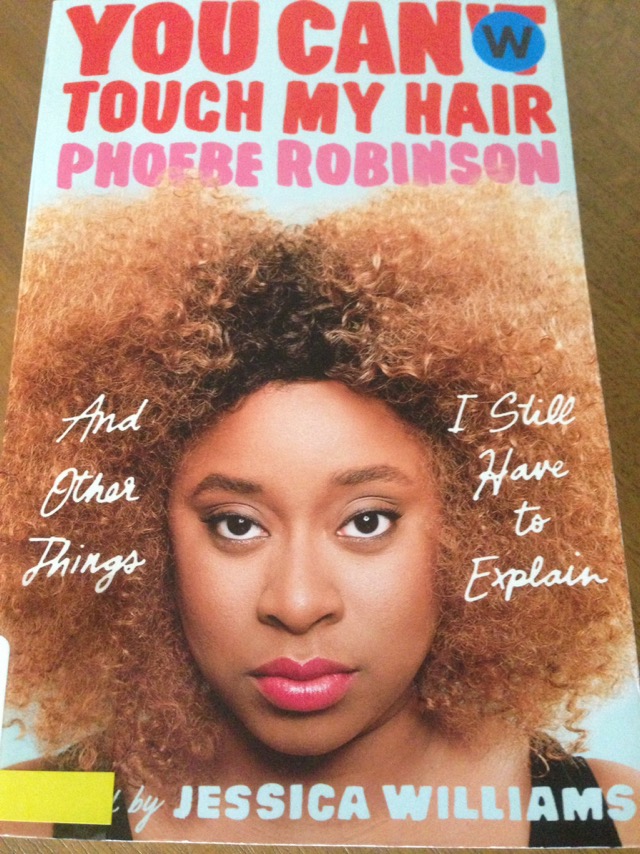
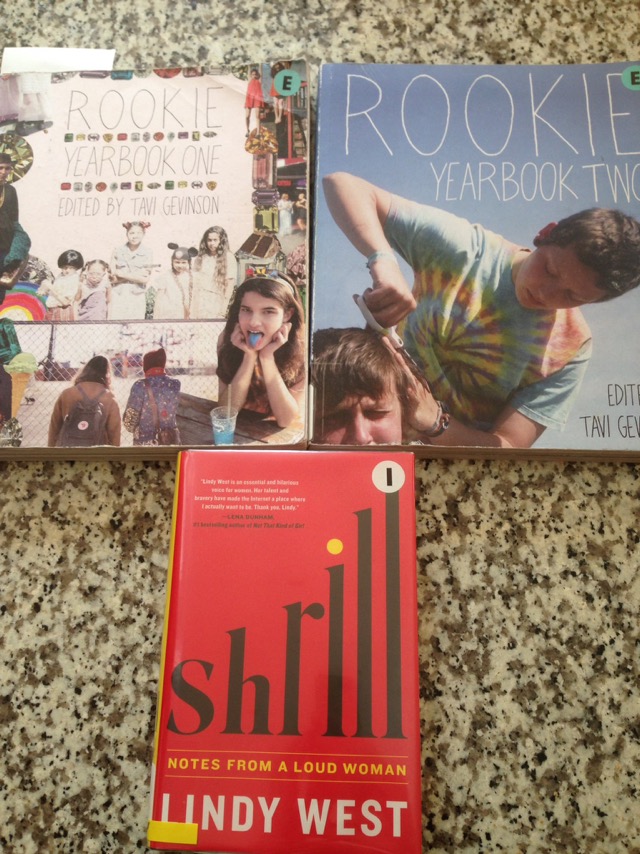
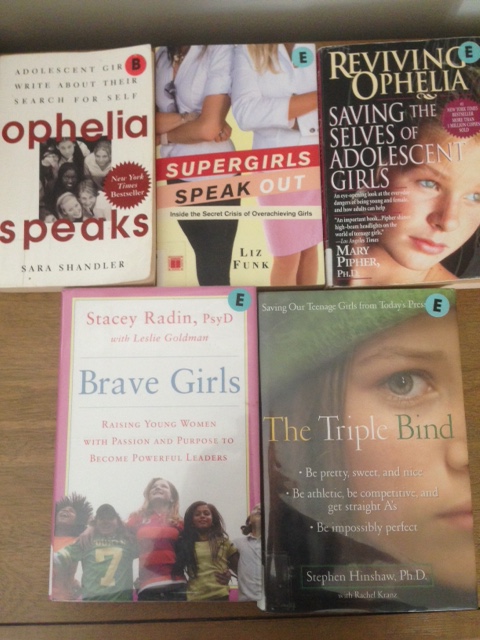
I tend to not talk about whatever I’m writing a whole lot. Well, that’s not true. I tend to not talk about whatever I’m writing a whole lot except to my husband, who is sort of a captive audience. With the cult book wrapped up for now, I’m working on something new. I love research and digging around for inspiration probably more than I love writing (a lot of days, it’s debatable if I like writing at all). It took me about 2 years to even start calling my last book a novel and not “a novel-shaped thing.” And Seth, one of my best friends for nearly 30 years, one day not long ago texted me that he didn’t know what my novel was even called (he refers to it as Ruby Roller, Girl CEO, which is not the title, sadly) even though I’d been talking in roundabout ways to him about the book since I first started kicking the idea around. All of this is to say, I’m writing something new. It’s about feminism and good girls and bad girls and mental health and finding your voice. Right now I’m calling it Code NameHeadless Tchaikovsky, which is not the actual title I’ve given it (at this point), but is far more entertaining to me.That doesn’t need to make sense to you; it barely makes sense to me. I spend a lot of time lying on my office floor, thinking about my book. Some days I even feel kind of okay about what I’ve written. Here’s a look at some of what I’ve been reading for inspiration.
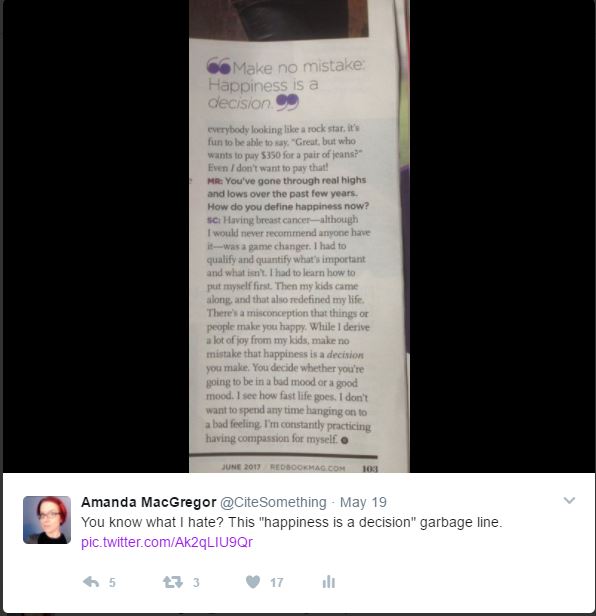
As a person who lives with mental illness, there is a lot of trash people say that makes me either roll my eyes or feel the edges of a rage blackout start to close in. In no particular order, here’s crap I hate. Please feel free to share your pet peeves with me, too, on Facebook or on Twitter.
“Don’t worry about it/so much.”
Oh! That’s so cool! I have had anxiety disorder my entire life, but it has never occurred to me to just STOP worrying about something. What a simple fix! Done! I’m all better. God, do I feel like an idiot for not trying this before. Thank you!
“Have you tried yoga/deep breathing/essential oils/exercise?”
Yoga:What a great opportunity for silence to really let my brain go wild with horrible thoughts. Also, am I doing this right? Holy crap, I am so not doing this right. This is just another thing that is awful. Deep breathing:Oh god. Wait, how do we breathe again? Holy crap, why do I never think about how breathing is the thing that keeps us alive? And now I feel like I can’t. Ugh… this makes me realize how rapid my breathing usually is. Will this make me pass out? Life is awful.Essential oils: NOPE. Exercise: Fine. Yes. If I put on a podcast and go for some exercise, I can get out of my brain for a while and tire myself out. But wait. Slow down. This rapid breathing and racing heart makes me think of panic attacks. Oh shit. AM I having a panic attack? Two miles from my house?
“Just think about something else!”
Okay. Which thought should I move onto? The ones that inspire panic? The ones that inspire sadness? Maybe the ones that remind me all the horrors that have happened, might happen, could ever happen in the entire world to anyone at any time? There’s not some secret compartment of cheer and calmness in my brain and I’m just too dumb to access it. Here is literally the only thought that calms me, EVER: Life is utterly meaningless. There are 100 billion galaxies and I am a speck of dust in one of them. Nothing matters. You think that’s too dark/not true? Back off, yo, because THAT is the something else I can cling to.
“Think happy thoughts! Go to your happy place! HAPPY HAPPY HAPPY!”
My happy thought is that I am smart enough, in enough therapy, and medicated enough to not actually give a shit about this meaningless advice. Also, please get over your obsession with happiness. It’s annoying.
“Everything is fine/will be fine.”
Yes, only because I do the hard work of worrying obsessively about stuff. Oh, is that irrational? NO KIDDING. Also, look around. Tons of stuff is not fine. It is SEVERELY not fine.
“This too shall pass.”
Fine. Maybe. But once it passes, the next horrible thing raises its hand and gets called in, forever and ever and ever. Also, do you know what doesn’t pass? DEPRESSION AND ANXIETY. It will wax and wane. I will be treated. I will never be cured. So thanks for the reminder that it won’t actually pass.
And my personal least favorite:
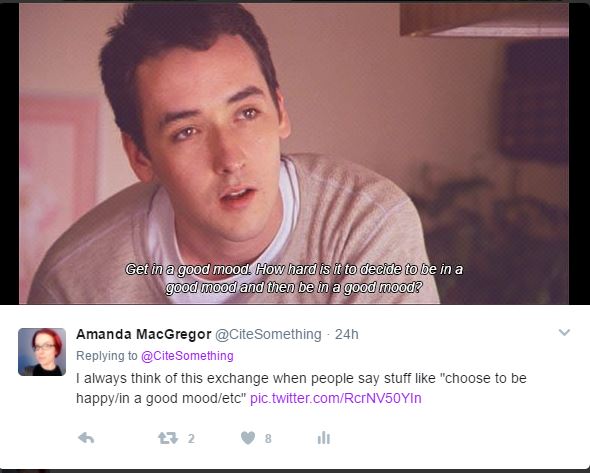
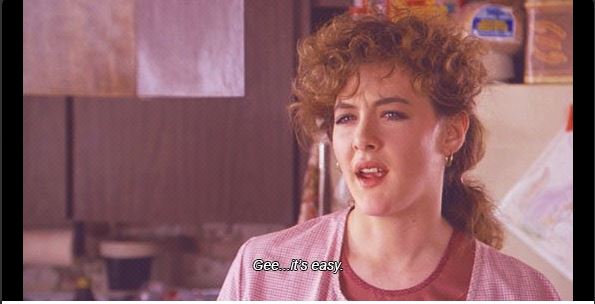
“Choose to be happy/not worry.”
Well, aren’t you superior. You just CHOOSE happiness and calmness. How nice for you. You’re right—I am obviously choosing to be miserable. My alleged “illness” is really just a moral failing. This is just like how people choose to have cancer or any other illness. God, why can’t they just get over it? I am so glad to understand now that I can just decide to be better and BE BETTER. This is revolutionary.
Teenage Amanda according to my high school boyfriend, Andy
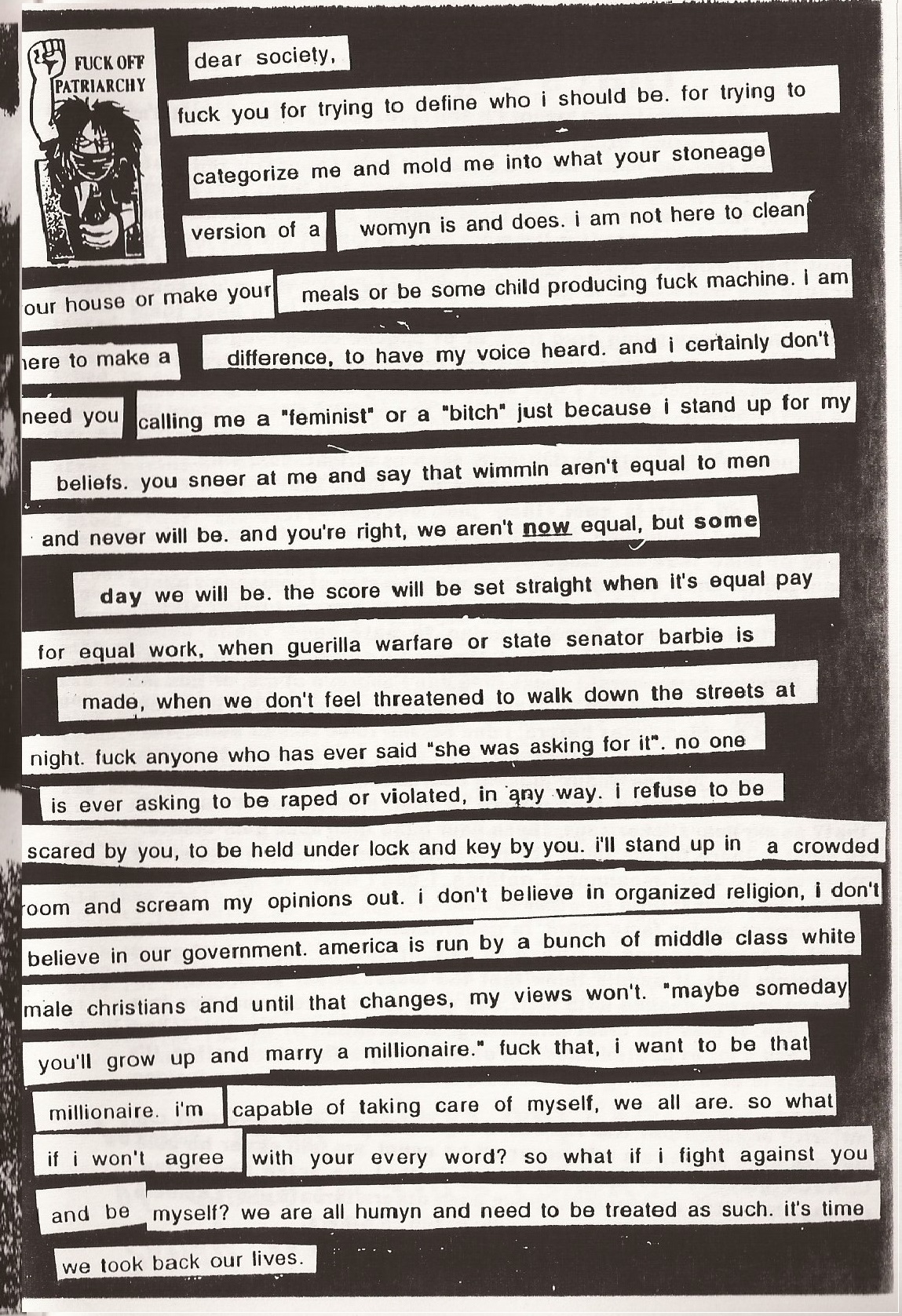
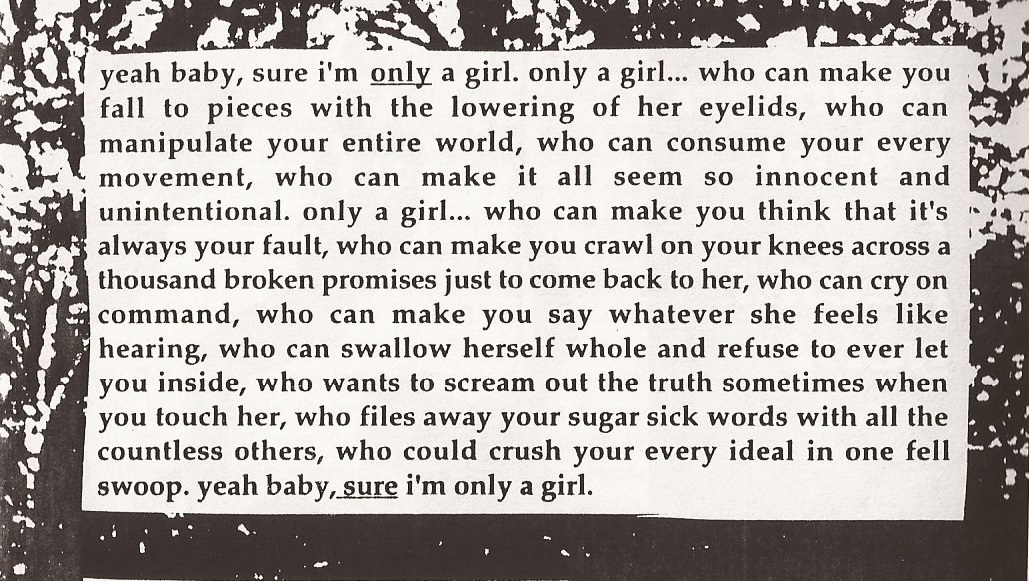
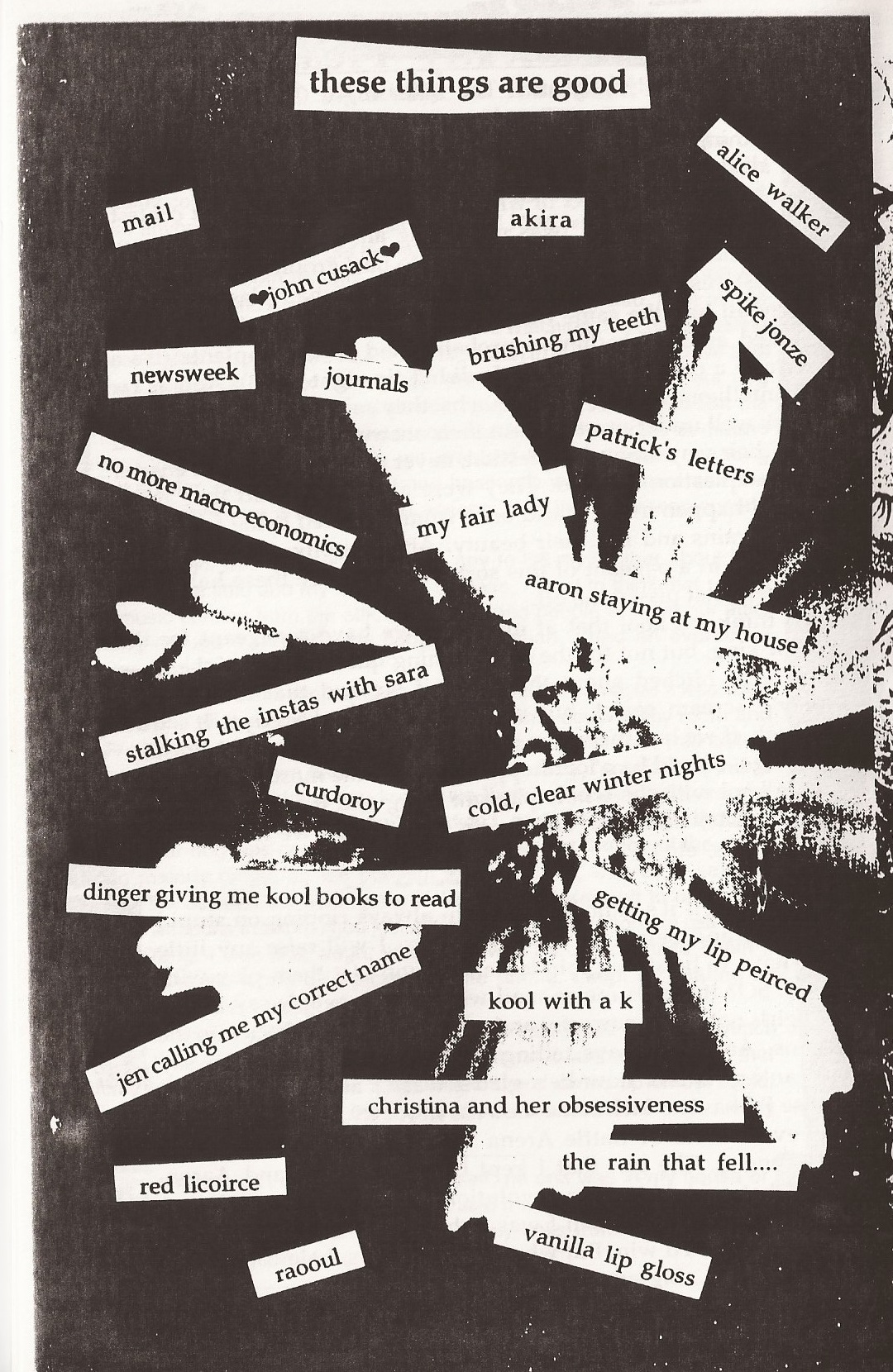
It was a few years ago (and a few thousand Twitter followers ago), on an old blog, that I last wrote about my teenage zines, so I’m going to write about them again. Because coming face-to-face with my teenage self never gets old.
Sharing my teenage writing 20+ years later is a special exercise in embarrassment. Maybe when I’m 60, I’ll look back at these blogs and other things I wrote recently and think, What the hell, circa 40-year-old Amanda? This is so embarrassing. But whatever. At least I’ve wised up enough to stop writing tortured poetry. The poet Billy Collins said we’re all born with 200 bad poems in us. I got all of mine out of me between 1992 and 2000. Whew!
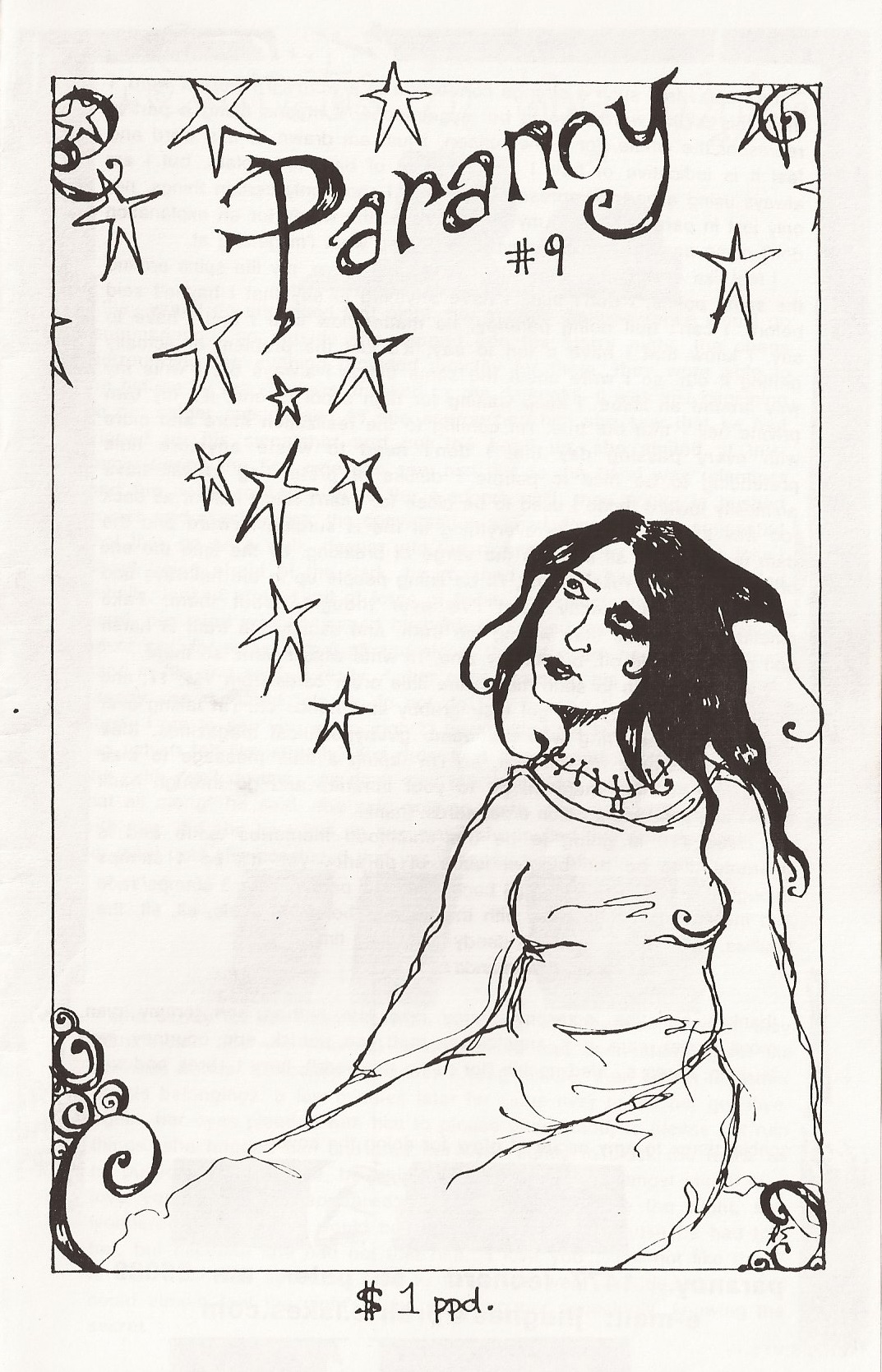
So. If you’re asking what’s a zine, I guess my two questions are: Where have you been? Clearly we don’t know each other, so how did you find this blog? A zine is a self-published magazine, or fanzine, from and about various subcultures. Zines have been around forever. I started to read zines when I got into punk music in my teens. I would pick them up at shows or record stores. They were usually a buck or two, or sometimes free. Then I started reading larger zines, like Maximum Rocknroll, Factsheet Five, and Punk Planet, which had many reviews of zines and ads for them, so I started ordering them through the mail (again, usually a buck or two or some stamps). Even though hating high school and going to punk shows took up most my time and energy, I figured I should start a zine in my free time. I liked writing. I liked pontificating on things. I liked projects with self-imposed deadlines.
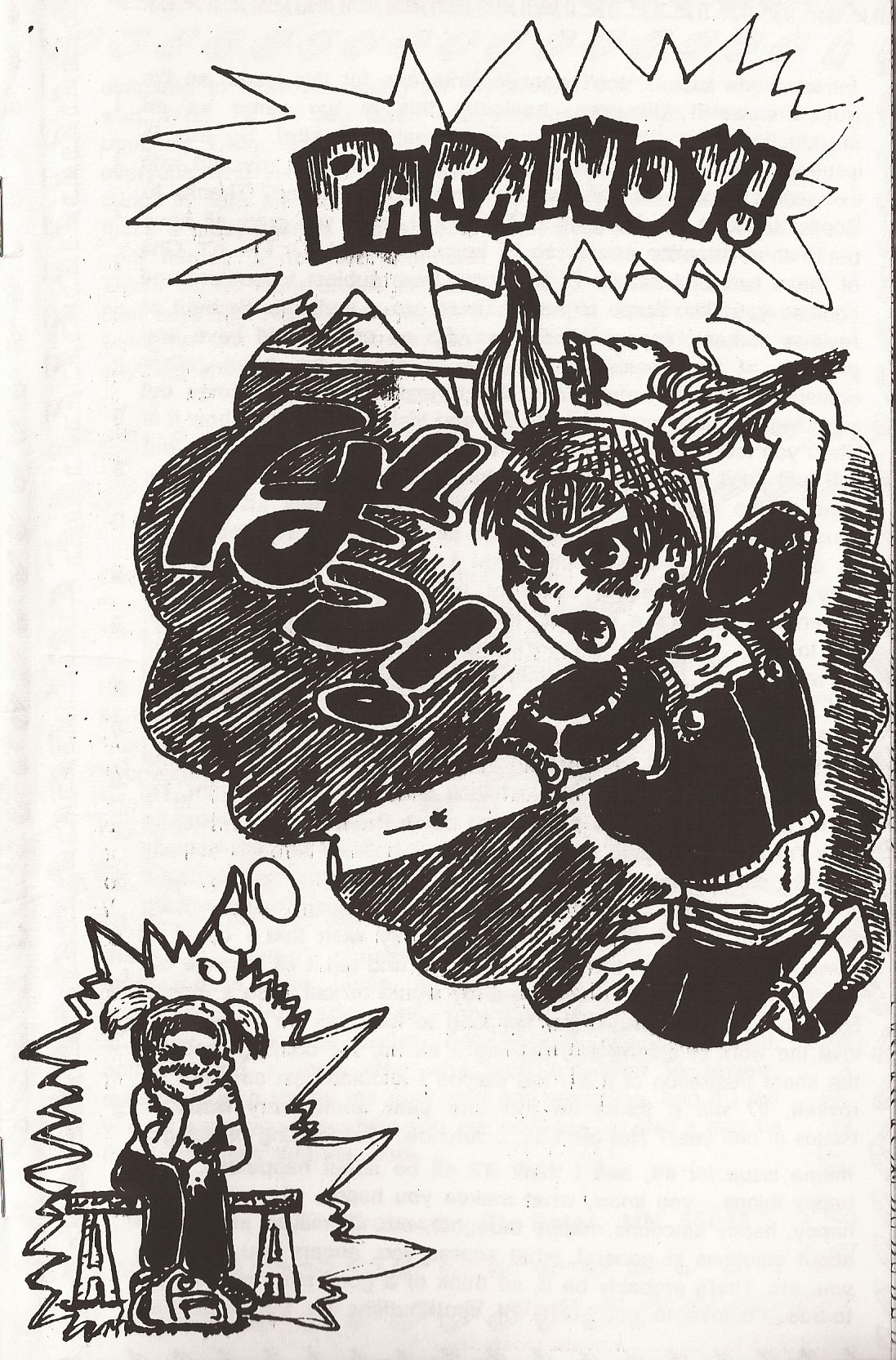
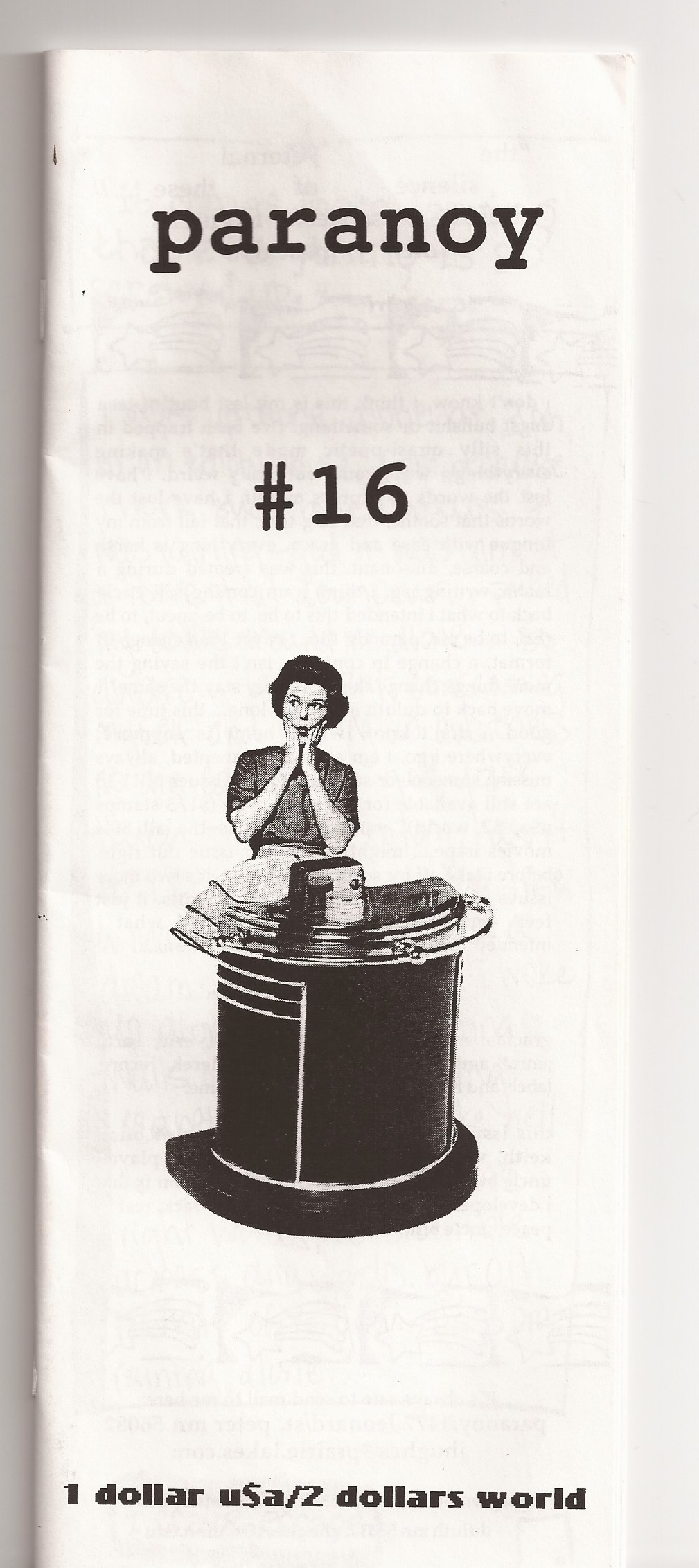
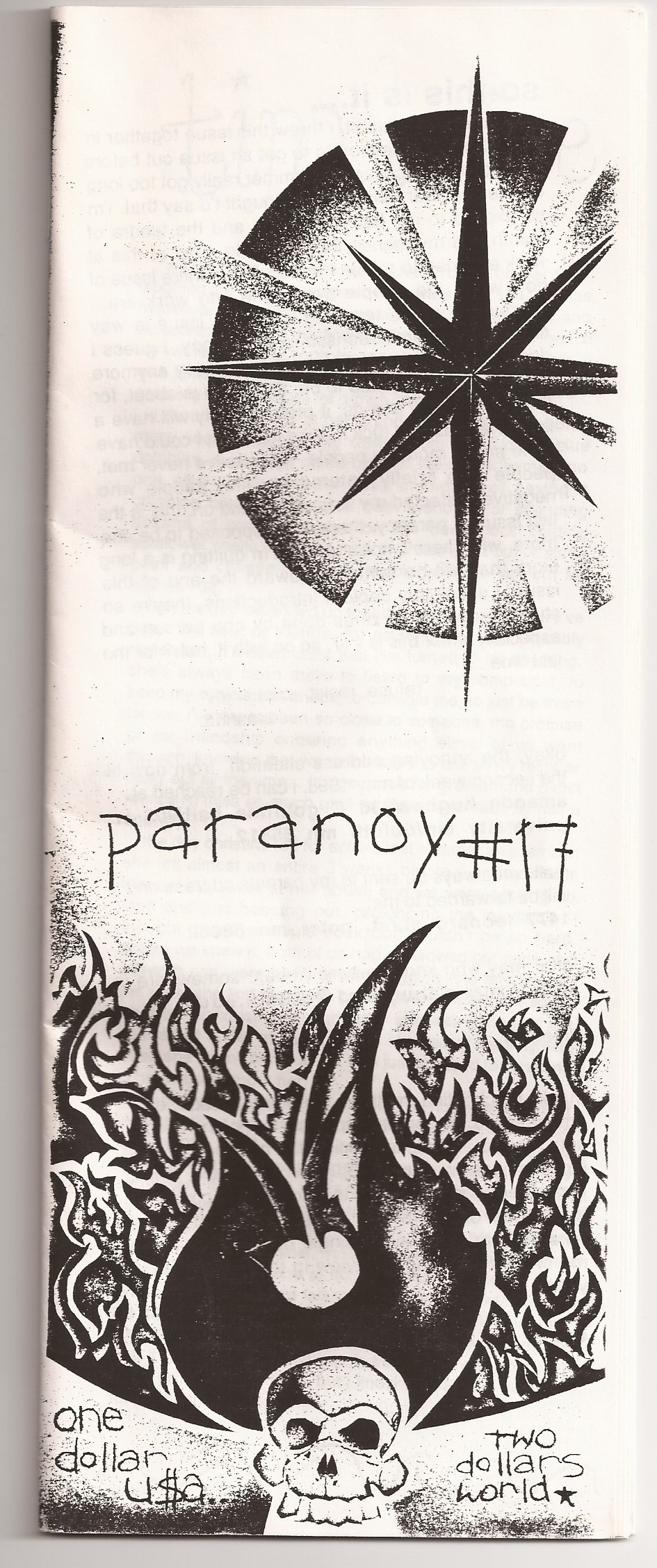
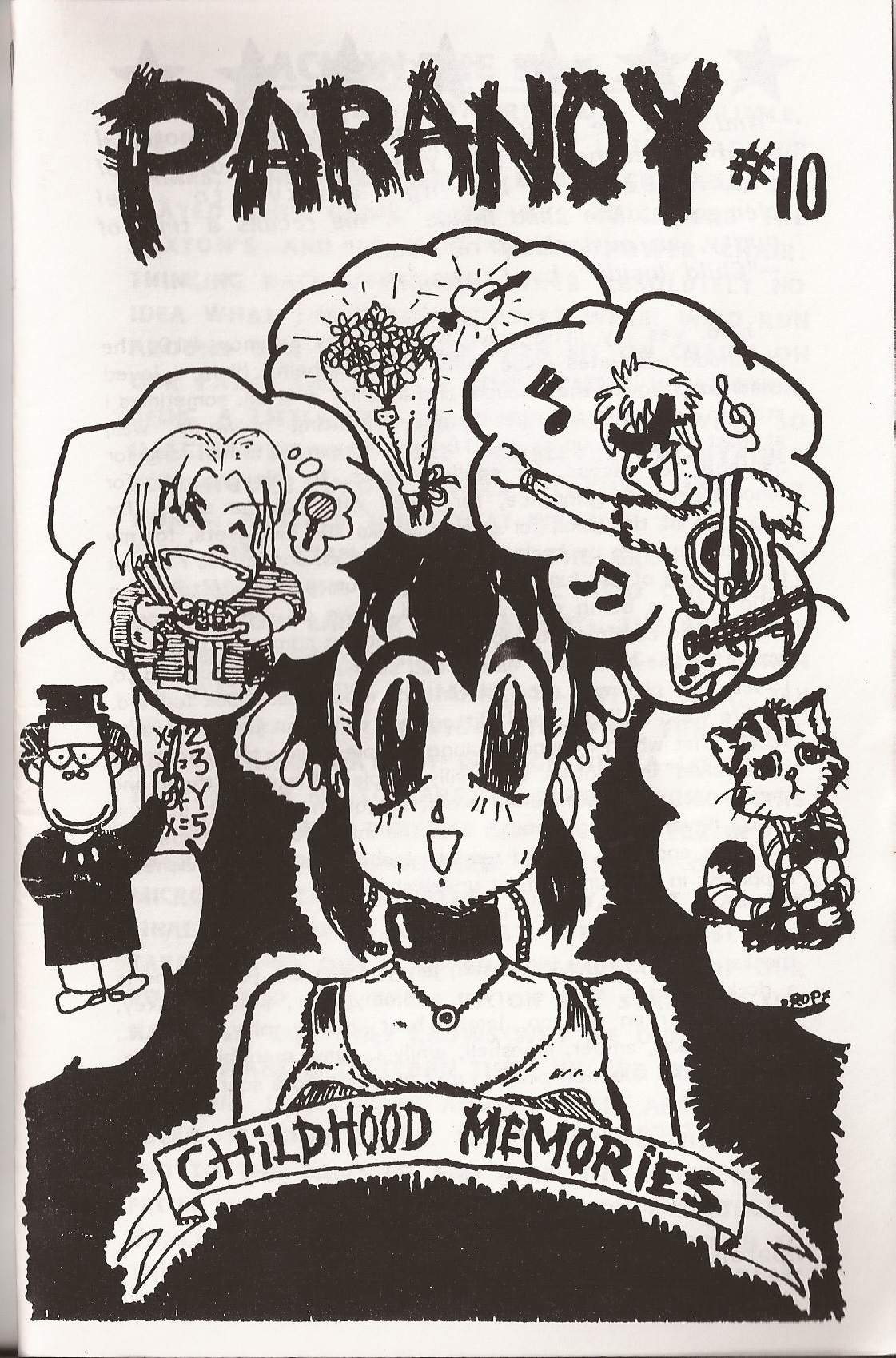
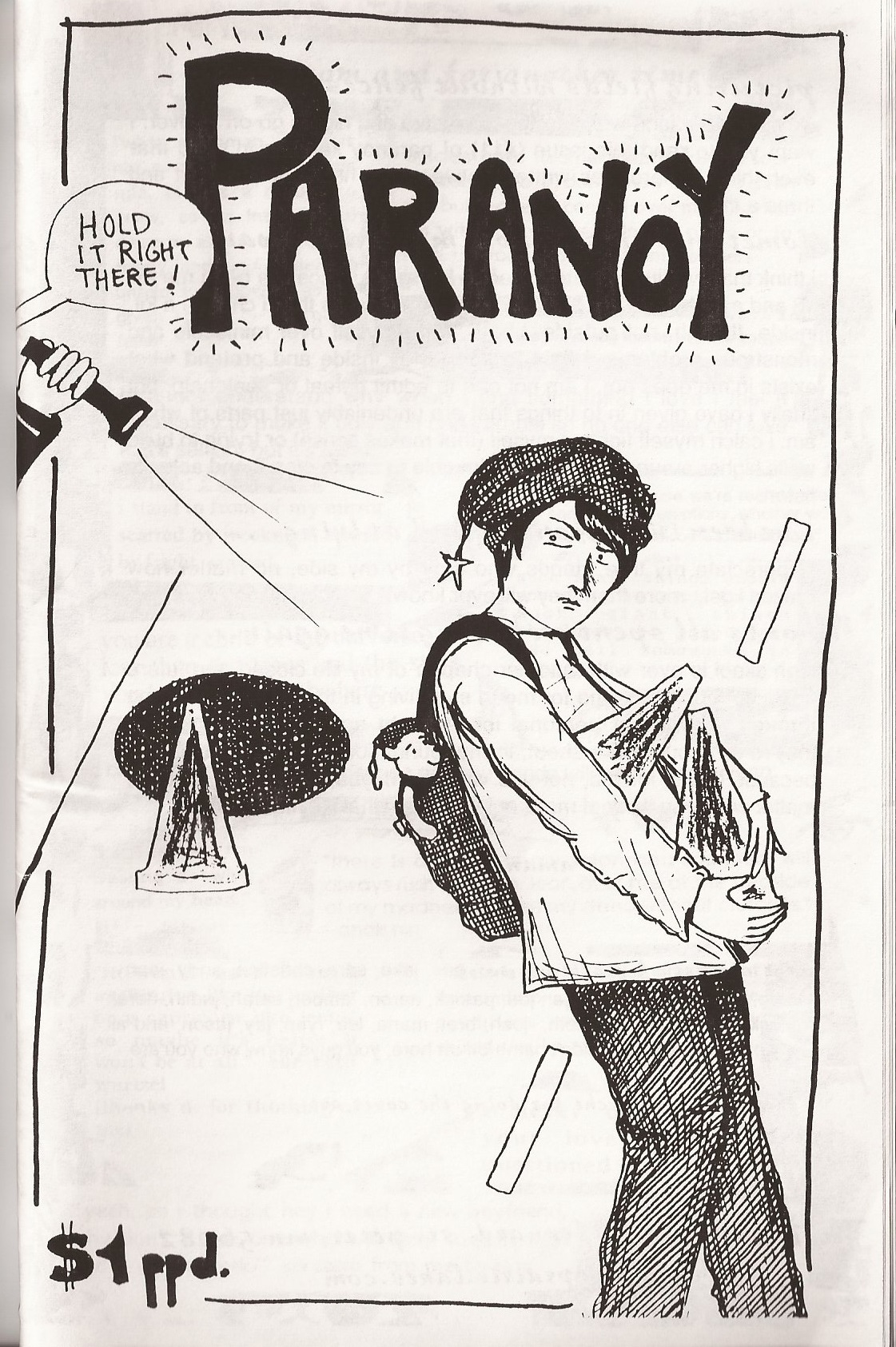
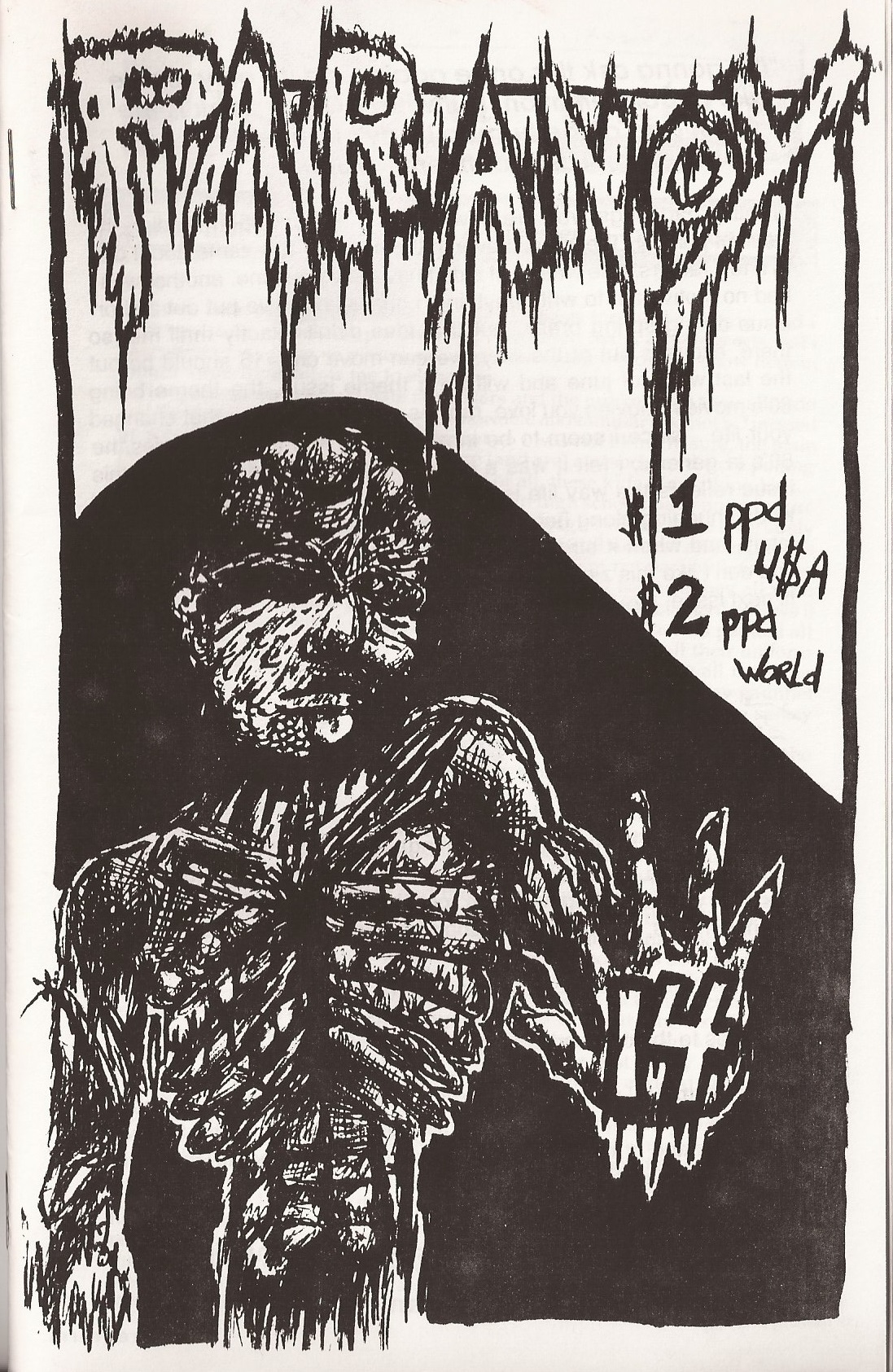
So, in December 1994 I started Paranoy zine. I wrote about my life, made lists, reviewed shows and albums, wrote shitty poetry, interviewed bands, forced my friends to contribute pieces, and more. I put out a zine every two months or so the fall of 1997. I put out 17 issues. I started out leaving them at record stores and punk shows. I mailed them to the big review journals. I traded them with a zillion other zinesters.
Eventually I was running multiple hundreds of copies of every issue, getting mail from kids all over the world. I struck up friendships with people that have lasted to this day. I honestly don’t know what I would’ve done without zines in my life at that time. I was involved in a lot of things at school and had other creative outlets, but doing a zine, this thing that was just mine, made me so happy. It connected me to people in ways I didn’t think were possible. As a surly punk teen in middle of nowhere Minnesota, it opened up a whole new world to me—one full of interesting creative weirdos who made me feel less alone.
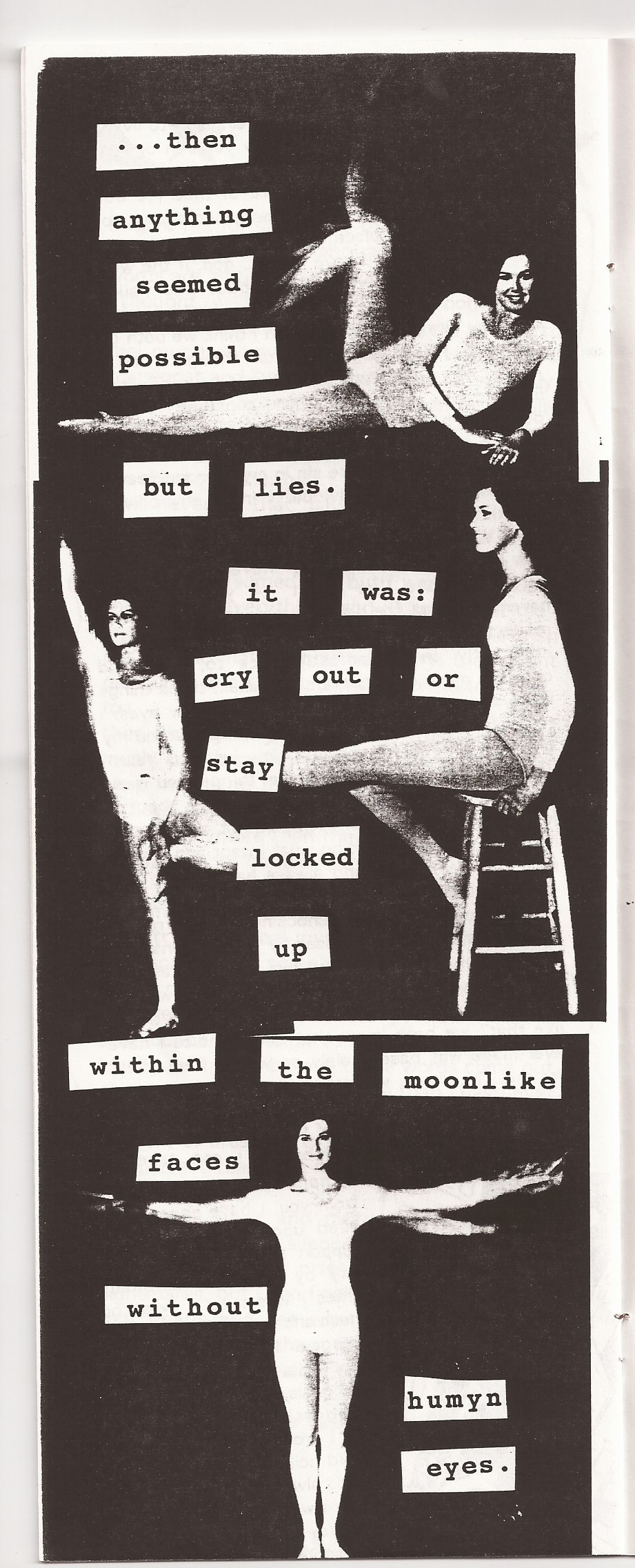
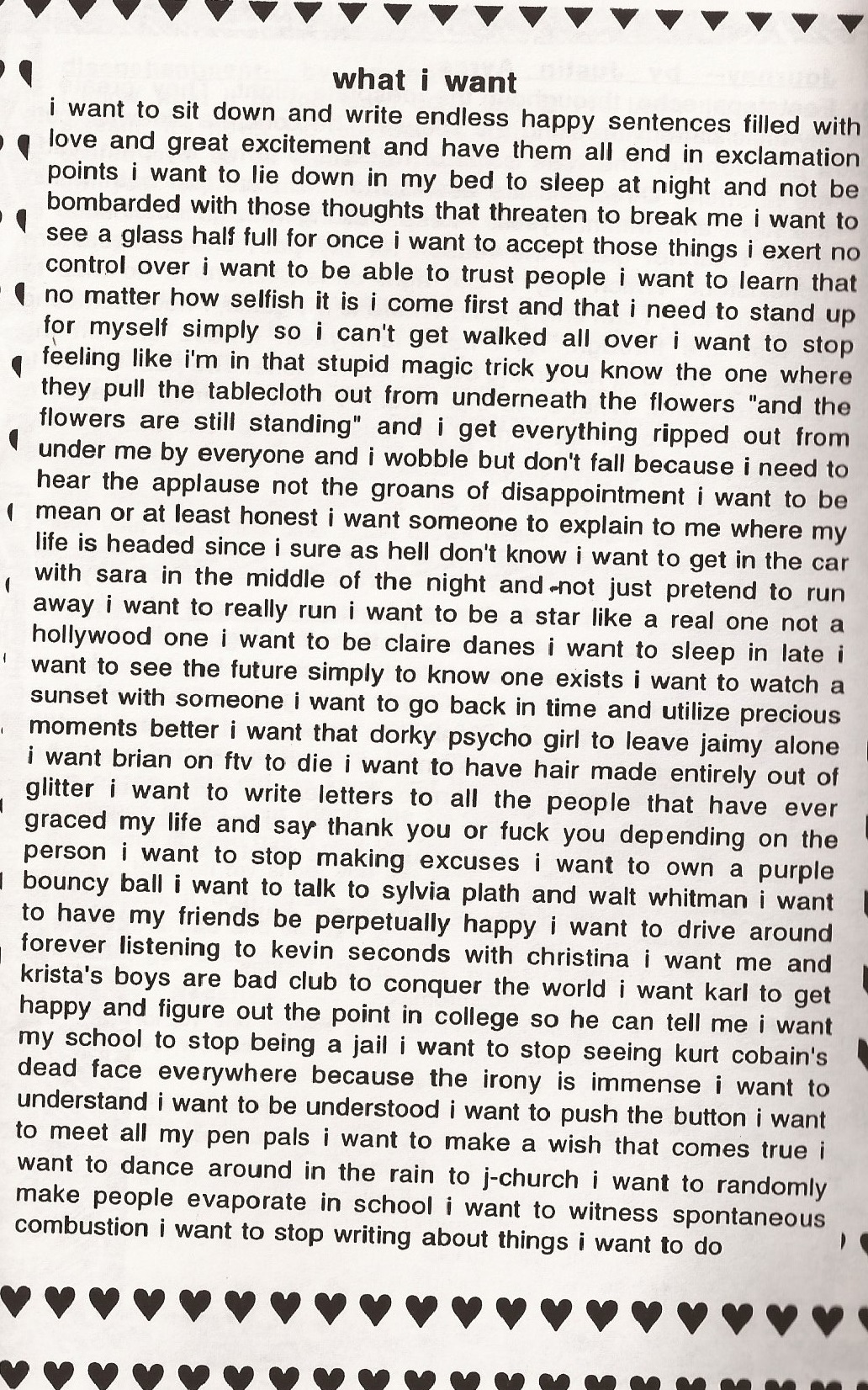
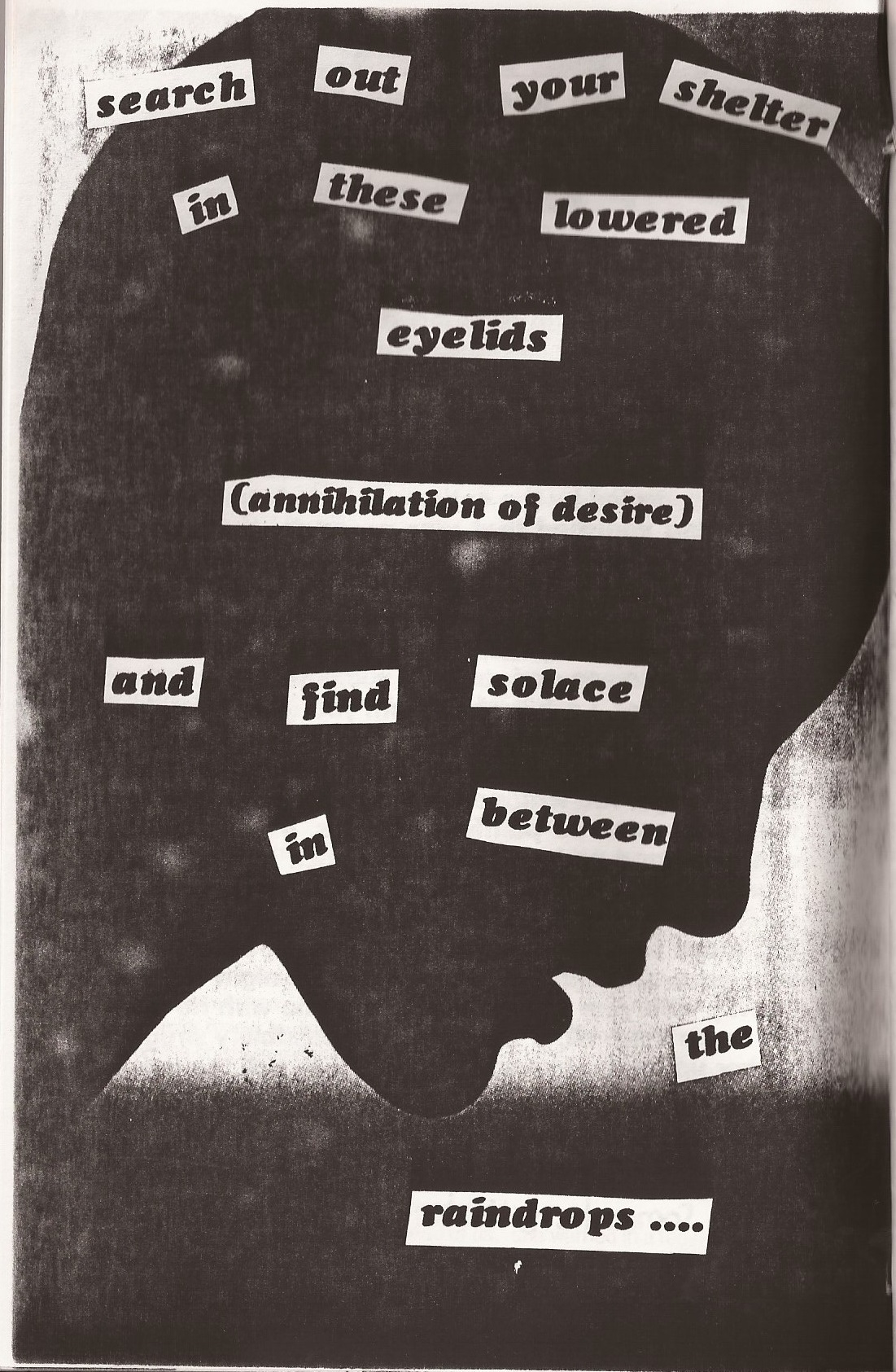
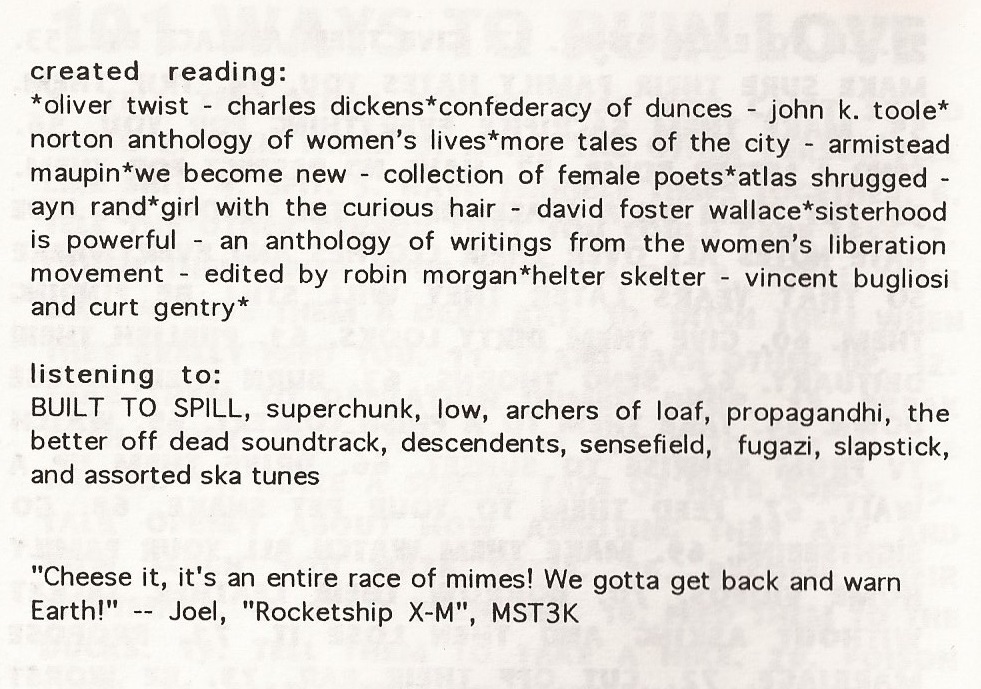
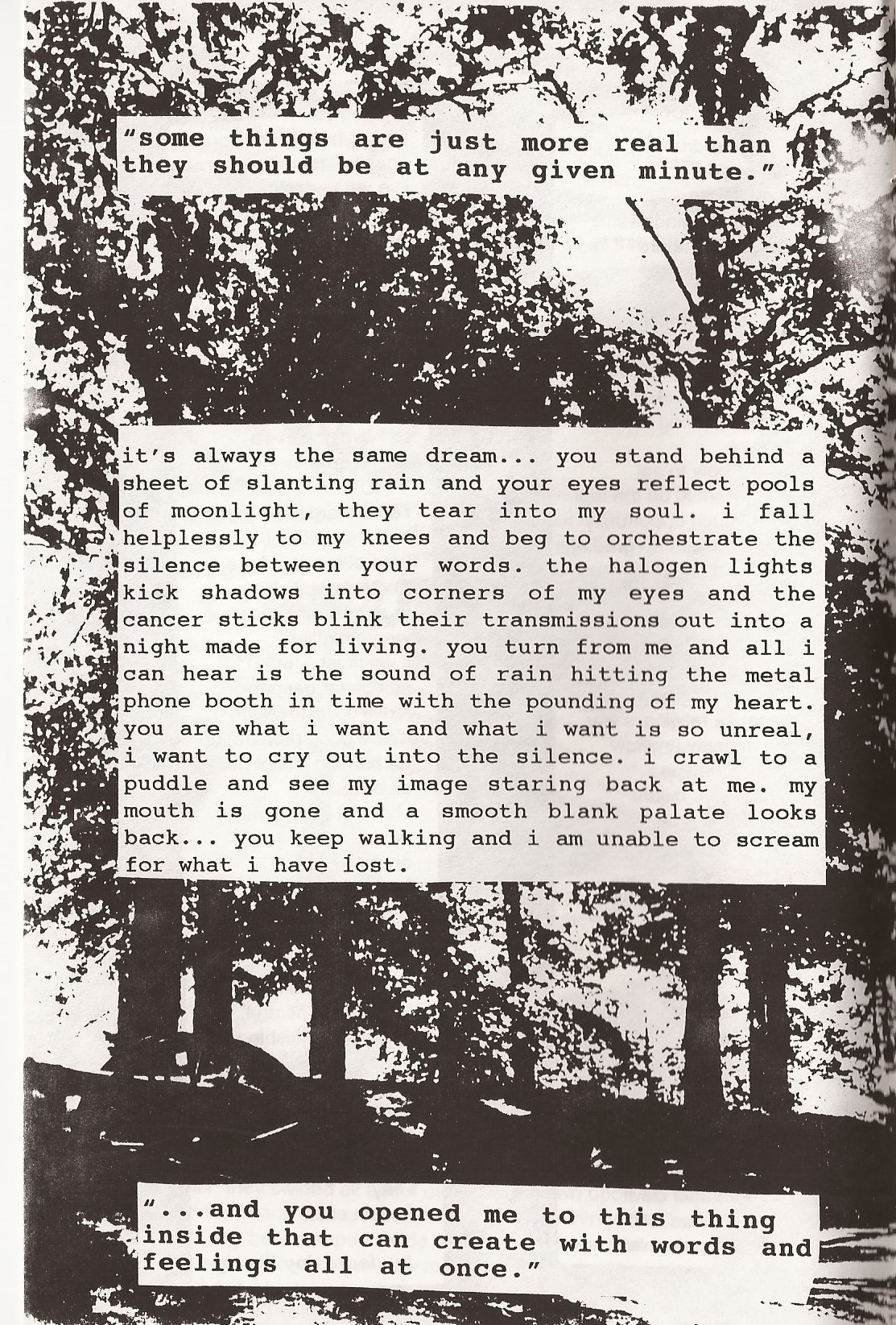
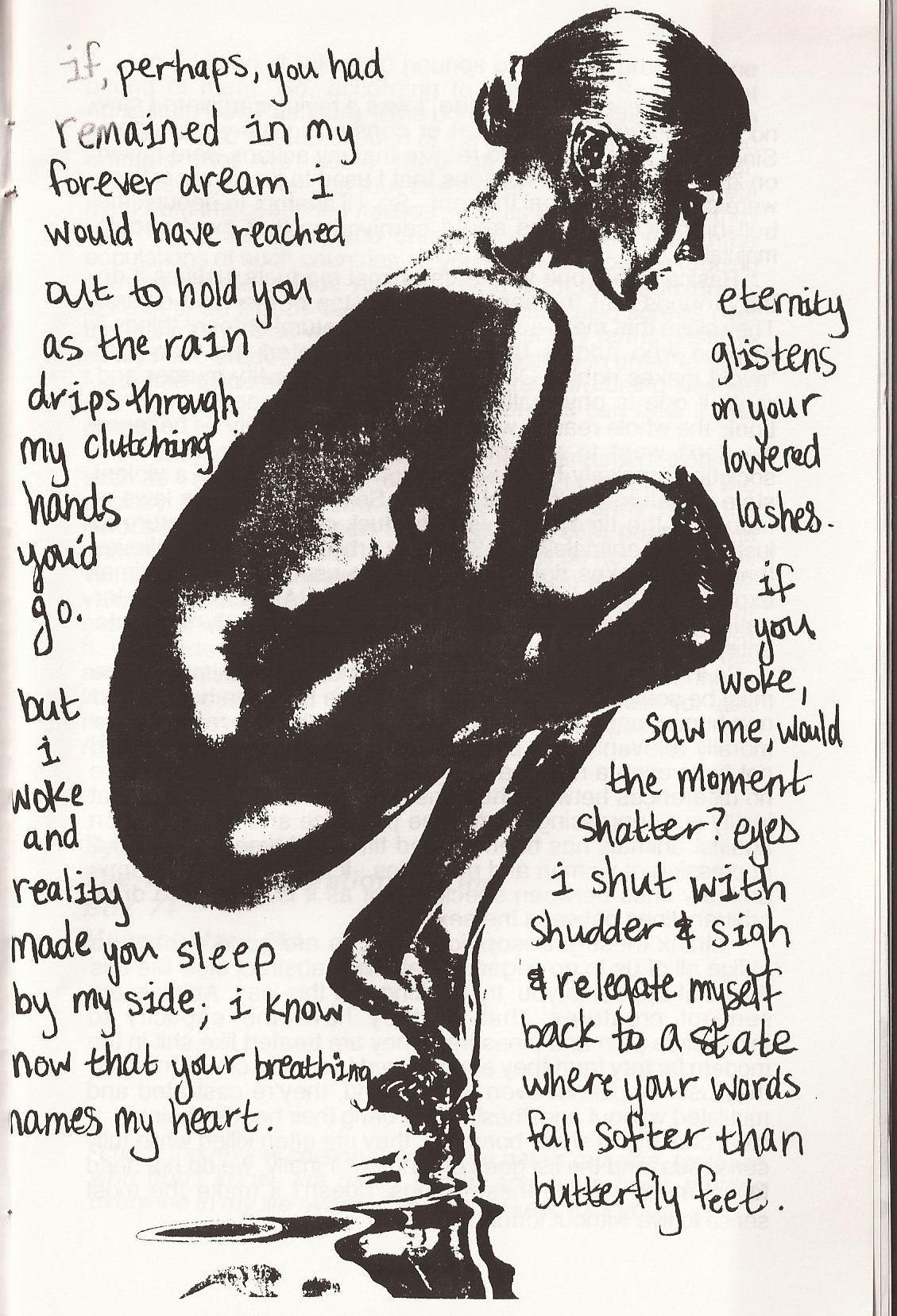
Here, for your entertainment (and likely my embarrassment) are some bits from my zines. I’m just going to post all the scans without any commentary. Teenage Amanda would not want Adult Amanda explaining her.
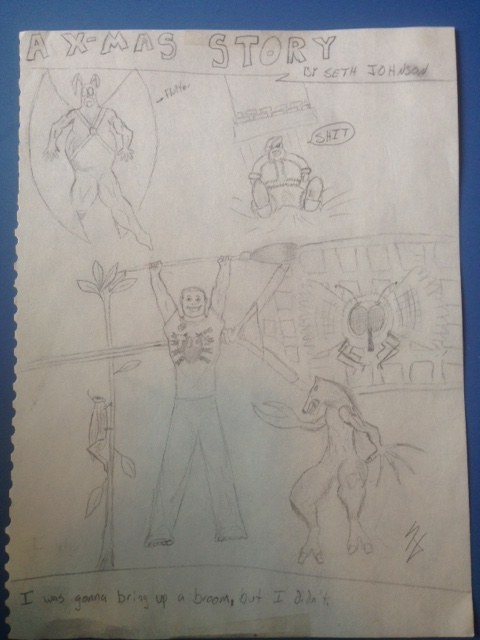
Not long ago Callum and I were looking through some of the bins in my office closet. Carefully tucked in between my high school, college, and graduate school diplomas was this faded drawing.
“What the heck is that?” Callum asked.
“Oh, this one time in college, we were on our way back up to school and Seth said to me, ‘I was gonna bring up a broom, but I didn’t.’ And because I am incapable of not making snarky comments, I told him, ‘Great story. You should write that down and illustrate it.’ And he did.”
Callum was like, “Ooookay.” Now, why I have kept it tucked into a bin of saved high school and college items for more than 20 years, I don’t know. Because it was funny, I guess. Because weird stuff makes me laugh. Because I’m not particularly sentimental about things or nostalgic for much, but odd things strike me as worth hanging onto—like a thing commemorating you being a sarcastic dick to your best friend and having him turn around and do the stupid thing you joked about.
“Wait, you’ve known him since college?” Callum says.
“Since junior high. Since we were 12,” I said.
“And you’re still friends?” Callum asks, knowing full well I spend lots of hours cackling into the phone with Seth.
“Yep. Let this be a lesson to you, as a comic book-reading, wise-cracking tween: Someday soon you may sit down next to some girl and attempt to copy off her homework and then you’ll blink and nearly 30 years will have gone by and you’ll still be friends, still talking about the same garbage you were as kids, laughing like loons.”
The look he gave me seemed to indicate, yeah, hard pass, but really, the real lesson is to find yourself the kind of friends who will not only tolerate your sarcastic mouth but rise to the challenge of it.
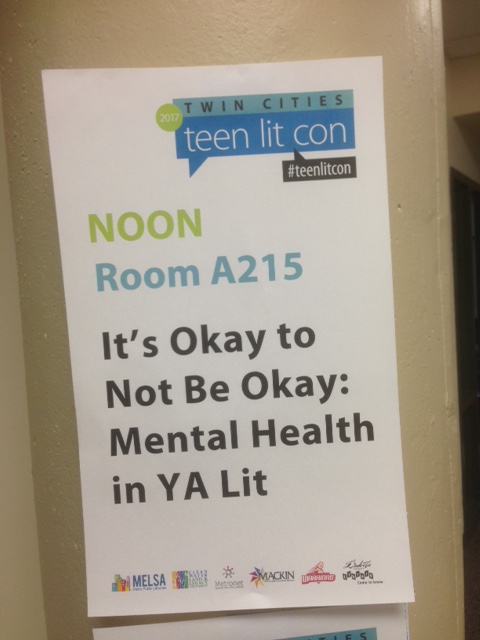
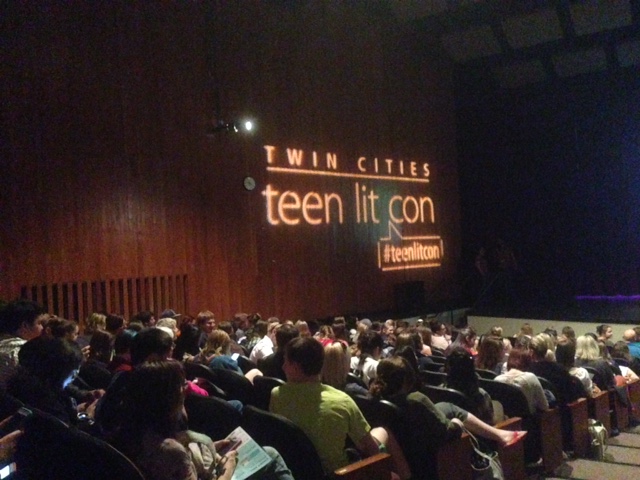
I spent this past Saturday at Twin Cities Teen Lit Con at Henry Sibley High School in lovely Mendota Heights, Minnesota. If you’re not familiar with Teen Lit Con, it’s exactly what it sounds like: a convention for teen lit. It’s an amazing day and we’re so lucky to have this wonderful convention happen here. Shout out to everyone at MELSA, the Teen Lit Con team, the many volunteers, and Sibley High for hosting. Smashing job, everyone. Thank you for having me.
Last year, I presented on new and forthcoming YA books and you can read more about that presentation and last year’s conference here. I had a blast and was delighted to be asked back for this year’s event.
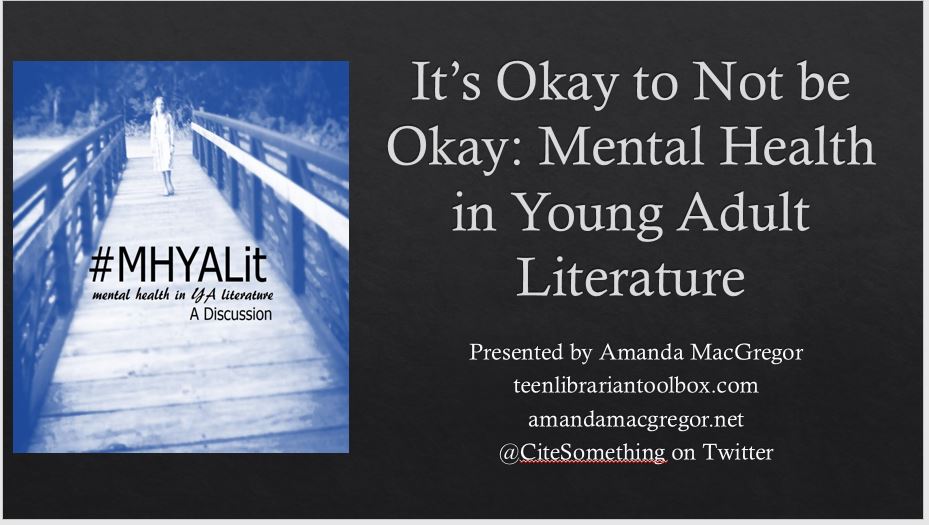
This year, I presented on mental health in young adult literature. I have presented on this topic before at NerdCon: Stories and for the International Bipolar Foundation (that webinar is archived and available in the link). Since 2016, we at Teen Librarian Toolbox have been running a Mental Health in YA Literature project (#MHYALit). This link will take you to the hub for our project, which so far has had well over 100 guest posts from authors, bloggers, librarians, and other teen advocates, often about our own mental health struggles and successes. This topic is one of my main interests and I never tire of talking about it.
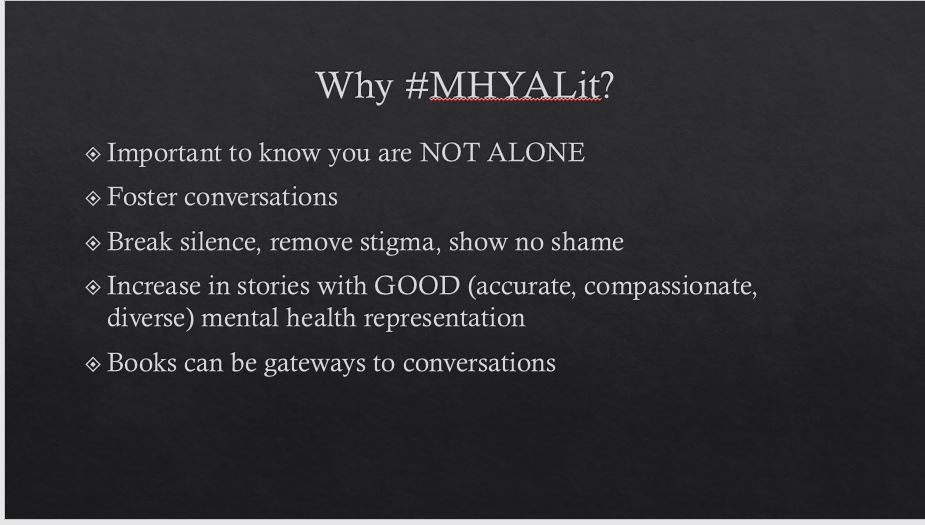
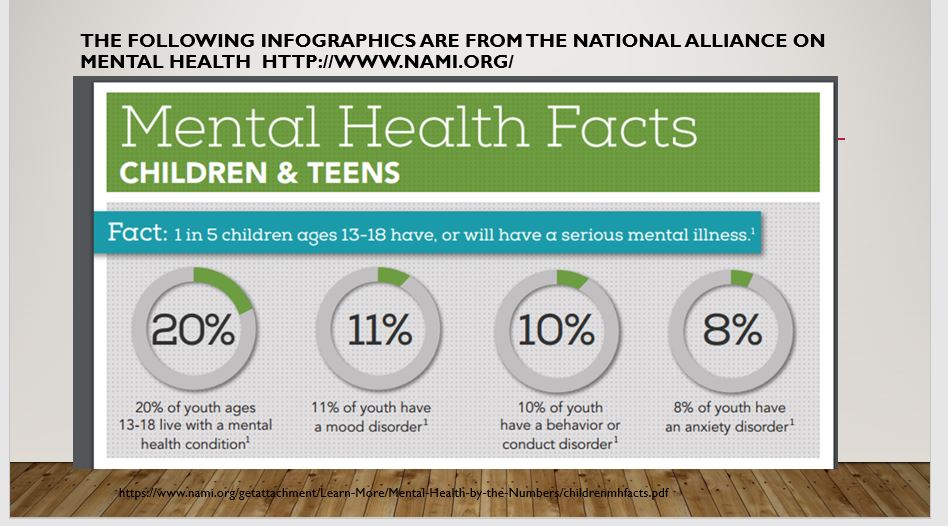
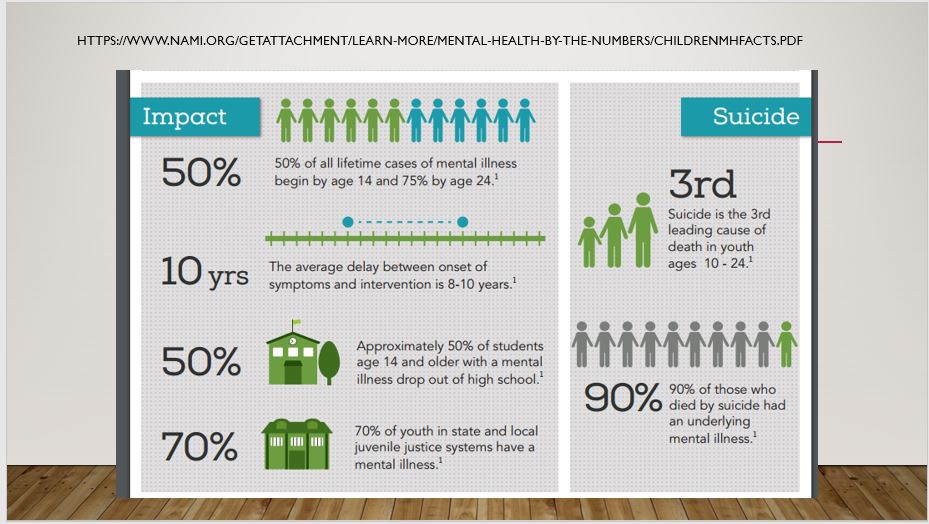
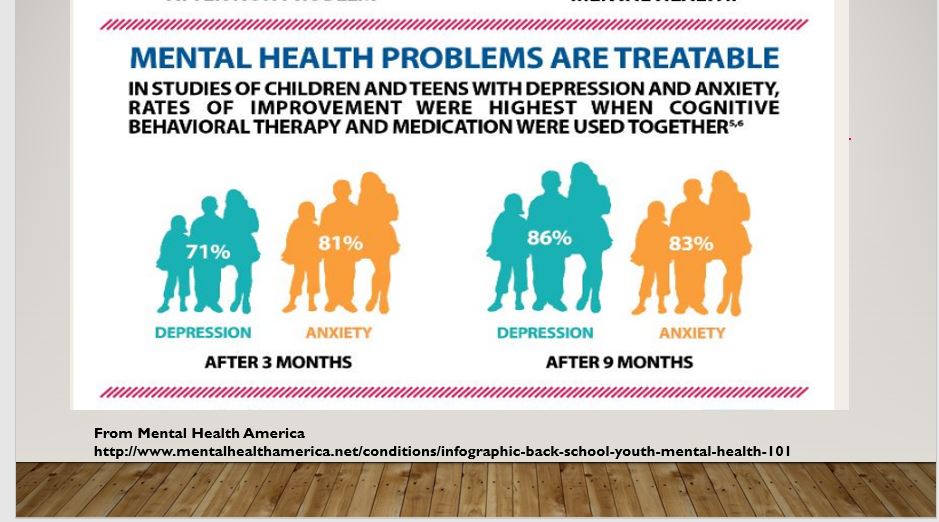
I pulled a few relevant slides from my presentation to post here. I did a lot of talking about my pet peeves, with examples; the reasons why good, accurate, and compassionate mental health depiction in young adult literature is so vitally important; the staggering statistics about teen mental health; and about some of the books I recommend. I also made a handout (because I love handouts) with roughly 60 recent YA titles that deal with mental health. That is available here: Teen Lit Con 2017 handouts MHYALit. Schools and libraries, please feel free to reproduce this and share this, but please leave my credit at the bottom of the second page.
The above slide is already outdated; suicide is now the second leading cause of death in youth ages 10-24.
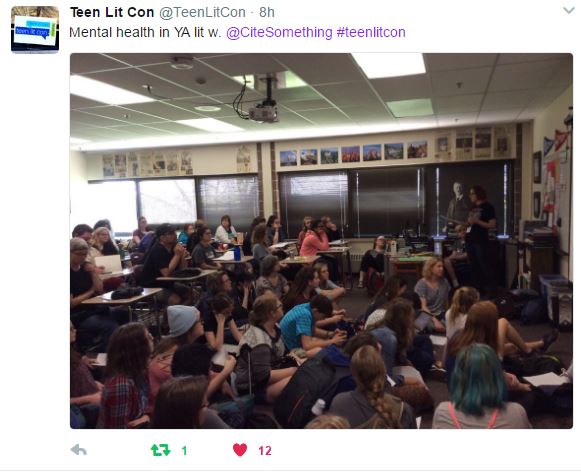
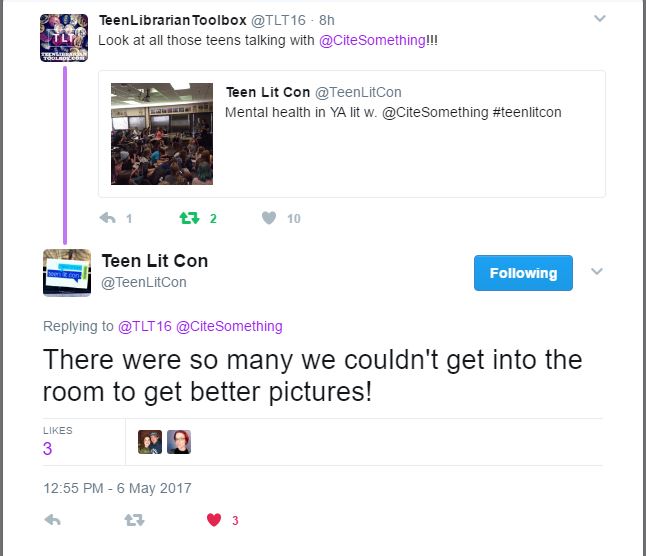
I was in a room set up with 35 desks. They quickly filled up, before my session, and before long people were settling themselves on the floor in the front of the room. More and more people kept arriving through the first many minutes of my talk, and before I knew it, we had packed over 100 people into that room. This is what happened at NerdCon, too: my room held 90 and we had 150 people in there before we were told we had to cut people off because we were becoming a fire hazard. What this all tells me is that this topic is vitally important to be talking about. There are so many who want to listen and who want to talk. There are so many who are so relieved to not feel alone. It was a wonderful session full of attentive listeners. So many attendees stopped by afterwards to thank me for speaking about this topic. There were some teary eyes and some hugs. We’re not alone in this fight. The reminder is so powerful.
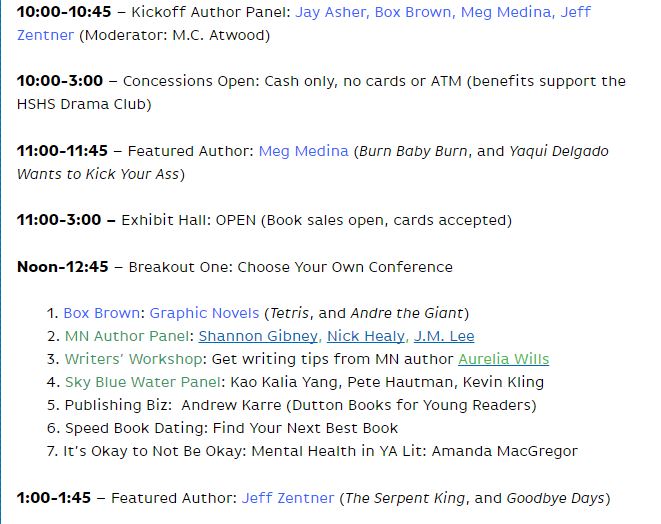
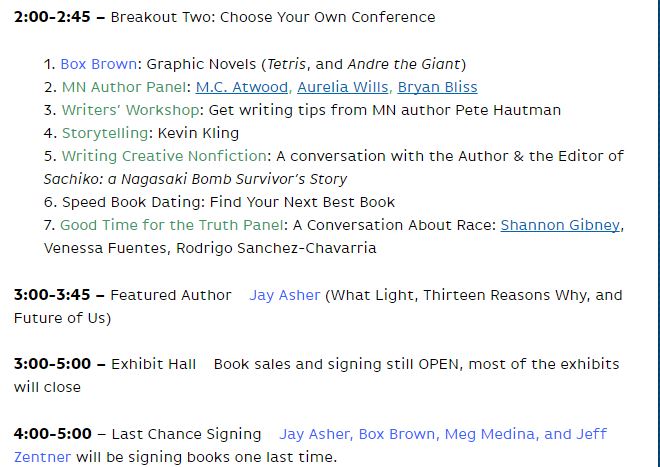
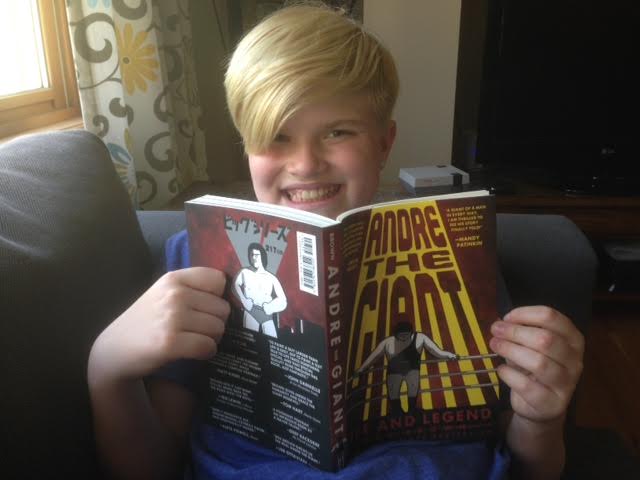
The rest of the day was also fantastic. We listened to Meg Medina, Box Brown, Jeff Zentner, and Jay Asher answer a bunch of great and silly questions during the kickoff panel. We checked out the gym full of activities and freebies. We attended Box Brown’s session and Callum was psyched to get his Andre the Giant book signed later on that afternoon. I was glad to see so many familiar faces and meet people I’ve only so far interacted with via social media. The Minnesota YA community is awesome and I’m so glad to know so many smart, interesting people in it.
Here’s what the full schedule for the day was (screenshot from the Teen Lit Con website). What a full day of great presentations!
Callum and I had an excellent time and are already looking forward to Teen Lit Con 2018! Hope we see you there!
Dudes, as this post’s title indicates, I will be talking about swears. If swears offend your delicate sensibilities, please go clutch your pearls far away from this post. And, probably, from me. I like swears. A lot.
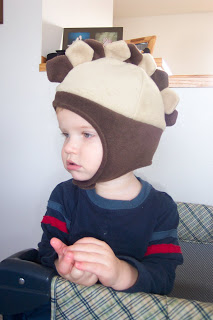
Callum, circa 18 months.
It’s 2008. My kid is like 18 months old or so. We’re heading out to go to an ECFE class. We did a million of those classes. I wasn’t super into sitting around with other moms talking about the minutiae of parenting, but I was super into getting out of the house. It gave me a reason to change out of pajamas. Put on some make-up. It gave me a chance to talk to other humans. I will never regret choosing to stay at home most of C’s childhood, but it was isolating as fuck.
Speaking of “fuck”….
So we’re heading to ECFE class. I’m leaving the house in standard toddler packmule mode: diaper bag, purse, whatever toys C needs one of us to be clutching at the moment (actually, this was during the Gerber toddler spoons as teething toys phase), travel coffee mug, winter gear, C on my hip. We go out to the car and I balance everything precariously to open the passenger side seat to dump most of the junk so I can then wrangle C into his car seat in back. And the car door is locked.
I’m holding what feels like the entire contents of our house and a wriggling toddler who had probably just thrown a tantrum over having to leave the house and I can’t open the damn door.
“Oh my fucking god,” I grumble, I think under my breath. Matthew last drove this car and still had the leftover Boston habit of always locking the car doors when he got out of the car. Even though our car was parked in the garage attached to our house. So I put half the crap down and fish around for my car keys and get everything in the front seat. I put C into his seat and go to harness him in. He grins at me and sort of sighs out, “Oh, fuckin.”
Oh. Oh, no.
“Oh, muffin?” I say. “Oh, bucket.” Uh… what else sounds sort of like “fuckin” but not close enough to still sound like it? NOTHING.
“Oh, fuckin!” he says, gleeful now. Yes. This is a satisfying thing to say, he seems to understand. And, little dude, I totally agree. But I thought we’d maybe make it a few more years till you’d be busting out the swears. (Side note: I was probably this same age when I would stand in my playpen and holler out “Jeez Christ!” thanks to all the times I heard my dad get pissed at the Atari games he played and snap, “Jesus Christ!” Apples and trees and whatnot, right?)
So we make it through class without him saying this and I think maybe we’re good. But, later that day, it’s back. “Oh, fuckin,” he says, wandering through the house. “Oh, fuckin,” he says, really just to himself, as he plays. “Oh, fuckin,” he says, sweetly, to my mother when she next sees him.
I try to not react. Reacting will just make him do it more. As Matthew says of us on our current street, we’re kind of the Munsters of the street, and we felt that way on our old street too. I didn’t also need to add my toddler teaching all the other toddlers their first swear. But my mom and Matthew bust up laughing every time he does it, no matter how hard they try to resist. C’s teeny and sweet little voice will come out of nowhere. “Oh, fuckin.” I mean, it is hilarious. It just is. But look. I already have the kid who sat at ECFE classes as a newly semi-verbal wee one and asked his teachers politely, “More coffee?” holding out his little cup. He wanted water. But he learned the word coffee first. Because MacGregors.
You know, MacGregors. The family who lets their toddler drink coffee and swear.
I don’t remember a whole lot of C’s first milestones. I was tired. Who has the brain capacity for that stuff? I know he started to talk at 10 months. He started to put together small sentences before he could even walk (16 months). Beyond that, it’s a blur. First word? Who knows. But baby’s first swear word? That one is seared into my brain, every detail. It makes for a great story. And I often find myself, exasperated over some detail of life, sighing to myself and saying, in that same offhand tone C used, “Oh, fuckin.”
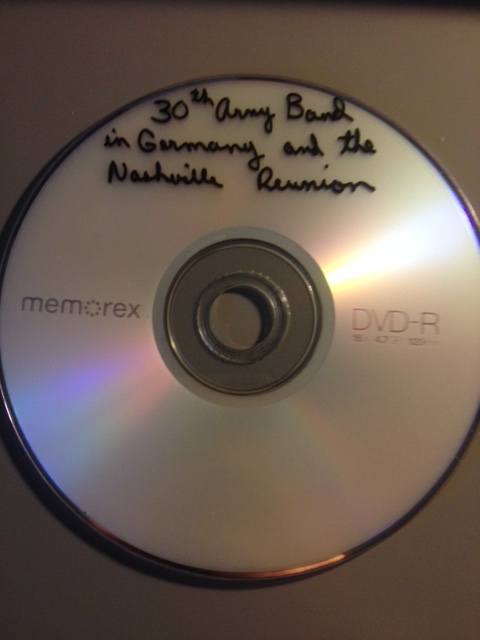
It’s the early 1970s, in Germany, in this grainy, soundless home movie that I’m watching. Young members of the Army band march by, on streets and on stadium fields, performing elaborate formations and marching with far more precision than any band I’ve ever seen. Every once in a while, a blur of trombones will pass by and I lean in, trying to somehow make this faded, too-far-away footage become clearer.
Somewhere in that lineup is my dad.
We fast forward past more marching until we see scenes at a swimming pool, skiing, and sledding. There’s no way I can tell who is who—everyone is far away, moving too fast, and so incredibly young. My kid lolls on my office floor remarking how terribly boring this is. He thought we were going to see grandpa. My husband patiently sits through the admittedly boring footage, too. We’d been looking at old pictures the other day and Callum had shown Matthew one of Grandpa Jim he was going to keep out. Matthew started to tear up. “Are you crying?” asked Callum. “I loved Jim,” my husband says. “He was a good guy.” He pauses a moment. “He was also a terrifying guy.”
I’m sure hundreds if not thousands of high school students who had my dad as a principal over the years would say the same thing.
Later that same day, I’m in the kitchen listening to Terrible, Thanks for Asking. “How come every podcast host sounds the exact same?” Callum asks. He asks this about once a month. “Everyone sounds like Hillary Frank,” he says. That’s one of the first podcasts he remembers listening to (The Longest Shortest Time)—and the only one he’s ever been on—so she’s always his go-to host. He listens a little more. “This is really sad. All of the episodes are sad, aren’t they?” They are. “I heard you listening to one about a dead dad. How can you listen to that?” he asks, concerned. “Doesn’t it make you cry? Doesn’t it make you think of grandpa?” I do cry, I tell him. But whether it’s grief or parenting or mental illness (hello, The Hilarious World of Depression), there is comfort in hearing stories like your own. In the shared horrors of loss or parenting or our brains.
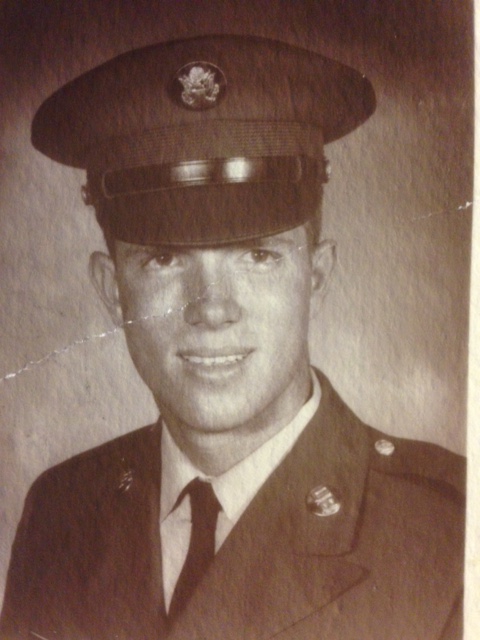
My dad, 1969.
There were other chapters to watch on that home movie—things recorded at various Army band reunions over the years. I didn’t watch them. I can’t yet. It’s been nearly four and a half years since my dad was killed. One of his buddies from the Army band days sent me these DVDs not long after he died. I didn’t even take them out of the bubble wrap until the day I watched them this past week.
Some days my brain still refuses to actually believe it. I see a red Jeep driving and think, for a second, that it’s him. Even though I know he’s dead. Even though I know that Jeep was obliterated by a semi-truck. It is not him. But for a second, my brain goes, maybe. It’s the same way I sometimes see someone out of the corner of my eye and turn quickly, thinking I’ll catch him. My brain says, let’s be irrational. Maybe he’s still alive. And he’s following you. Just checking in.
Brains are annoyingly bad at filtering out irrational thoughts. Especially my brain.
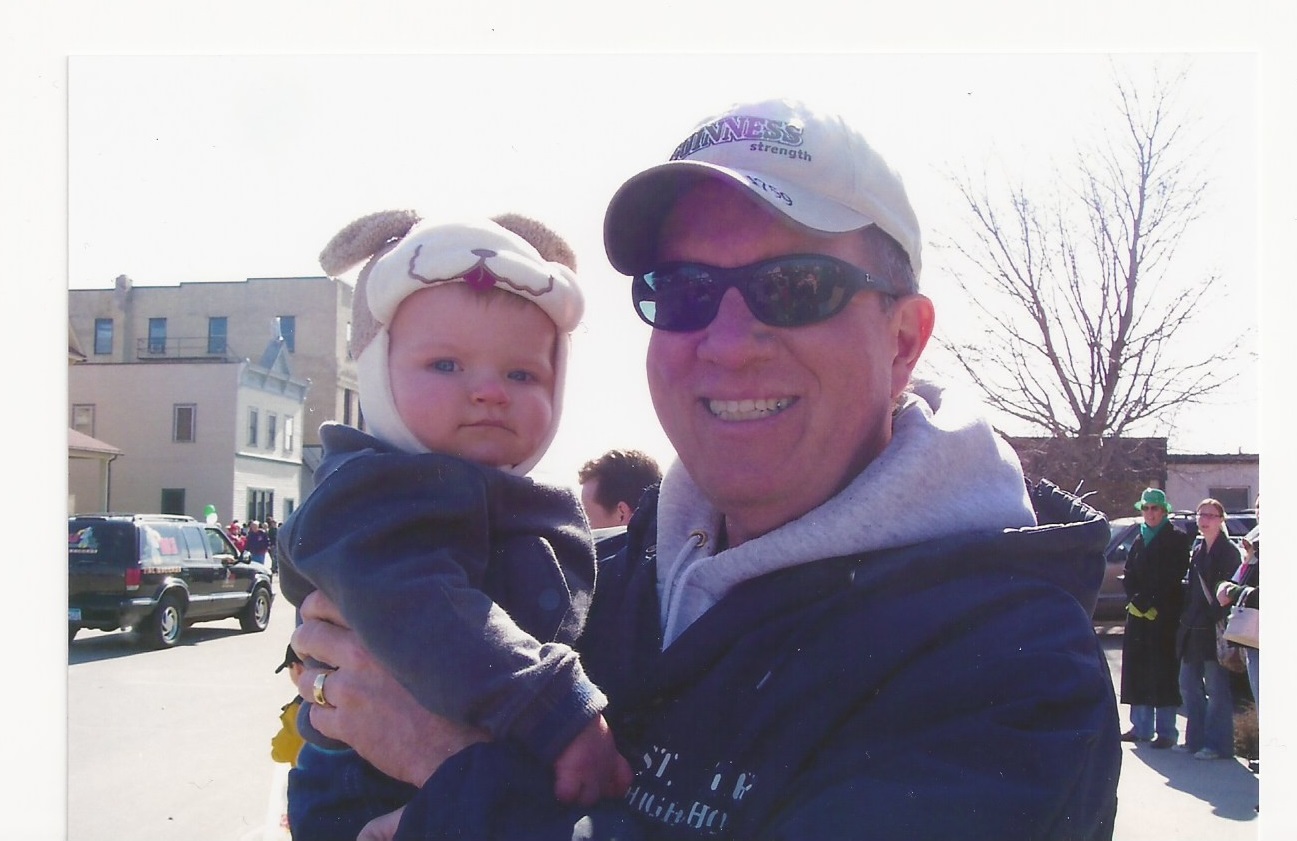
My dad and Callum, 2007.
My dad and I had a less than wonderful relationship, to put it mildly. The years since his death have been complicated for me. My grief feels equals parts for having lost him and for having lost the ability to ever have anything other than a relatively distant relationship with him. But I think about him all the time. Some days those thoughts are really cruddy and difficult—they’re thoughts full of stupid crap I’ve hung onto for too long or an endless loop of thoughts about how he died. That’s when I’m thankful for therapy and medication. Most of the time when I think about my dad, though, it’s in relation to Callum. My dad adored Callum. My dad would have loved to be able to listen to Callum play his trumpet—and, as a former band director with a master’s in music performance, would have had some thoughts about Callum’s lazy way of practicing while practically lying on the floor. He would get a kick out of Callum’s verbosity. He would probably be able to deliver a damn fine lecture to Callum about homework and school behavior (and probably scare the hell out of him, which would be so useful).
“I barely understood what it meant to die,” Callum says, as we sift through old family pictures. “You were so sad and I don’t think I cried much because I didn’t really get it.” He was only six. No one expected him to have to understand death yet—certainly not death in this horribly unexpected and gruesome way. “I was sad because I knew we’d never see him again.”
But there are so many things that remind us of my dad. Pictures, sure, and memories, but also things like Callum’s natural music talent, or the sly grin of both Callum and my brother, a grin that indicates mischief (and is the same grin my dad and my uncle, who died by suicide when I was just a kid, shared), or certain words we use that trace back to the large vocabulary of made-up words my dad and his siblings used.
I don’t know when I’ll be able to watch any of those other home movies. Maybe never. The 1970’s Germany footage was just crummy enough that I couldn’t tell which tall, thin, white dude in the band was my dad—and that was okay. That made it easier for me to watch. But I knew he was in there—young and alive. It was maybe one of the first times I felt able to be reminded of his life without also being shoved into a meltdown about his death. Slow progress, but I’ll take it.
My kid is making me almost quite literally lose my mind.
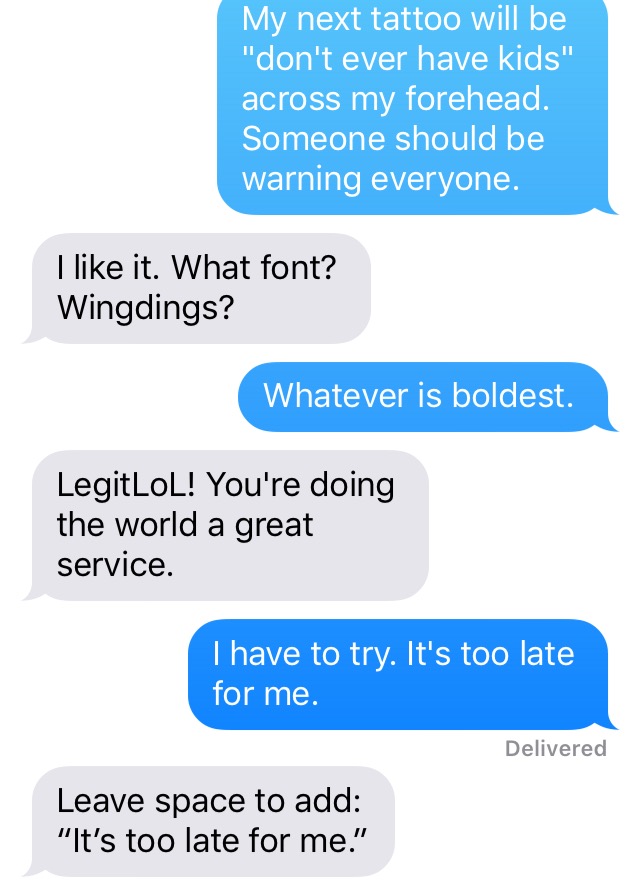
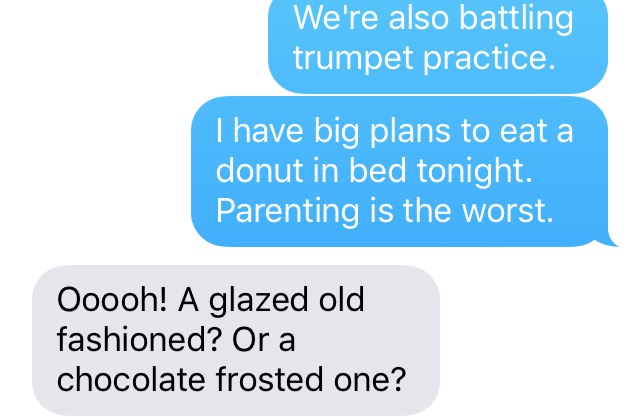
Those two statements are both true. I both love him and loathe every minute of parenting lately. He is both kind and the most stubborn person I know. He makes me laugh and makes me cry. A lot.
Oh the beauty of containing multitudes, right? Everything is terrible and wonderful all at once. But mostly, lately, it’s been terrible.
Some days I think, this parenting thing is not easy because I have depression and anxiety. That makes it worse. Other days I think, this parenting thing is not easy because my kid has ADD and anxiety. Yet other days (there are lots of days), I think this parenting thing is not easy because IT IS NOT EASY. My child is mulishly determined to make his own choices (such as stopping doing homework) and willing to die on that hill even though he understands why his choice sucks. He is temperamental, absent-minded, and completely uninterested in doing any task or finding any idea appealing it if generates from anyone’s brain other than his own.
It is exhausting.
The hardest parts of parenting are that there is no easy path for answers or “fixing” a situation. There is just no winning, some days. I feel like I’m doing a spectacularly awful job all the time. I feel like I’m failing this stupid endless job of parenting because I can’t get my child to do his homework (or any of the 64,000 other requests and demands I make in a day). Me, a person who adored homework and grades, who nearly threw up if I got anything less than 100% (look, I’m not saying my way to be is better), was offered the chance to skip two grades, and would still be in school forever if school were free. I thrive on doing well. I thrive on success. And with parenting, it has been nearly 11 years of feeling like I’m failing.
And I don’t need you to jump in and tell me why I’m not failing, or that we all feel like that, or any other kind things. Rationally, I get it. Trust me. I sit through plenty of therapy to talk about how rough parenting is for me and how things like my child’s failures (or things I perceive as failure) are not a reflection of me or my parenting. I get it. But I still get to feel what I feel. And anxiety and depression make sure that rational thoughts that sound remotely positive or soothing will never actually get through to my brain and override how I feel.
Here is what I am infinitely grateful for: I have many close friends who freely and loudly admit that parenting is terrible. That kids are sometimes just the worst and that we had no idea what we were really getting into when we had them. Being a parent (and particularly a mother) and saying to people, yeah, parenting SUCKS is still not really acceptable. I am supposed to find it rewarding. I am supposed to be endlessly patient and just so naturally maternal and giving and selfless. I am supposed to like this.
My kid has never been “easy.” From colic on, it has been a struggle. He is all the best and worst qualities of his parents. As my husband said recently, prior to this, I was the most stubborn person he knew (and let me tell you, the endless eye-rolling my kid does for sure is 100% me. I still roll my eyes that much). My amazingly smart husband will ask me a question, appear to listen to my answer, then 90 seconds later ask me the same question. Because he was still in his work-brain, writing an algorithm or something. This is what our kid does, too. Most of his qualities are things I find admirable, when spun in slightly different ways. He knows his own mind. He doesn’t care what people think. He’s determined to do his own thing. He’s independent and extremely creative. Those are all wonderful things, but they are also things that are hard to parent. I do not want to wear him down, to change him, to somehow make him fit in some kind of box. I just don’t want to feel like every second is a battle and nothing I say or do can change that.
I’d like to think we’ll hit an easy stretch soon and I’ll feel like I can breathe a little more, but heading into these middle school years, I feel like that’s not likely. And so we will go on. We will argue and cry and yell and stomp off. We will laugh and snuggle up and crack jokes and hang out. He will tell me he hates me, then six hours later, slip into bed next to me and wriggle his (not so little anymore) hand into mine and whisper he’s sorry. The days will be good and bad and endless and go quickly. They are what I signed up for. They are not at all what I signed up for. I will wish for grace and I will settle for survival. The days will contain multitudes. And we will trudge forward, carrying the weight of the bad yesterdays and the hope for a better tomorrow, not because we are good parents, or because we are patient (or because we can feign patience), or because of any indication that things will actually be easier, but because we have to. We hear from so many people this too shall pass. And it probably will. Most things do. But that doesn’t make it any easier. Fiercely loving your child does not magically erase exasperation.
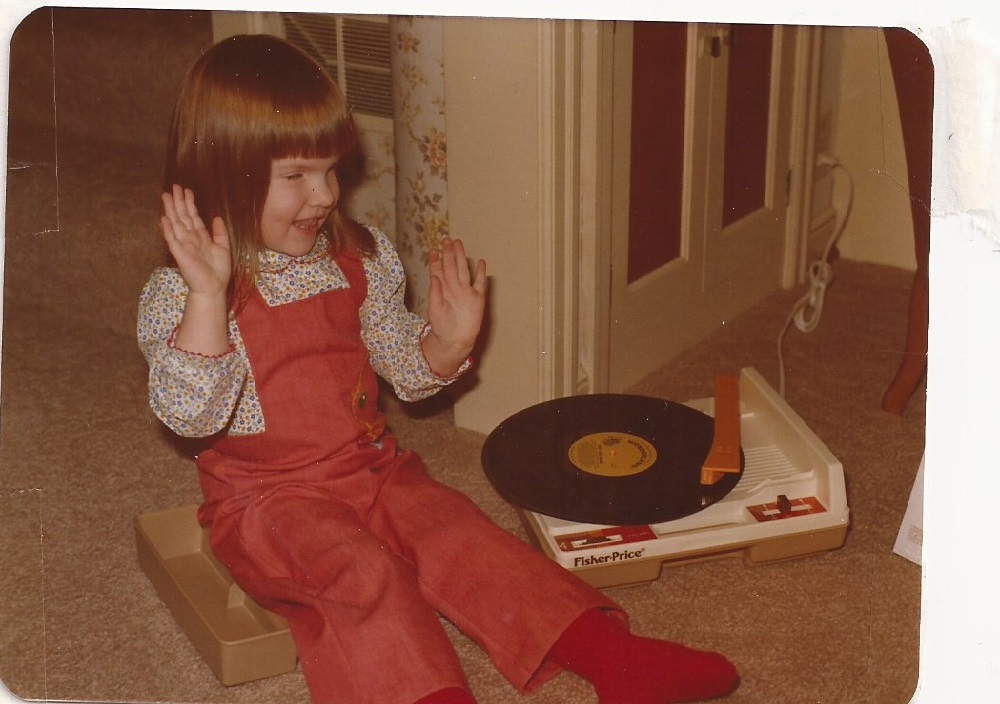
Christmas 1980. I’m 3. You can safely assume my imaginary friends are all around me.
When I was in Boston the other week, I was telling my friends about the imaginary friends I had when I was little. There were six of them: Boopsy, Bopsy, Beepsy, Goopsy, Gina, and Deena. Some names, right? They were tiny, roughly Smurf-sized (three apples tall). I liked that they were little because it meant they could stand on the table next to me while I ate and tag along for most things. I could sweep them up and carry them with me. They spent most of their time at my grandparents’ house in Mankato. It’s not that I didn’t play with them or see them at my house, but they mostly came out at my grandma and grandpa’s house. They slept at night on the blades of a fan. During the day, they liked to play in my grandma’s walk-in closet, particularly in her neatly arranged shoeboxes. I definitely played with them and routinely thought about them up until third grade, when I guess I decided they were too babyish or maybe I just found enough real-life friends that they weren’t necessary anymore. But I still think about them a lot.
My own kid didn’t have any imaginary friends, but having them is a really common thing. This Science Friday article says “up to two-thirds of children have them, typically between the ages of 3 and 8.” Odds are, some of you reading this had imaginary friends, or have kids who have/had imaginary friends. Come tell me on Facebook or Twitter about them. Oh–and if you want to go read some horrifying things kids have said about their imaginary friends, head on over to this Buzzfeed article.
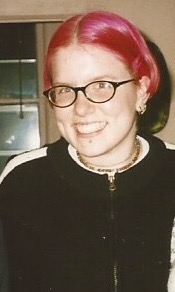
Maybe it’s because I don’t really feel like I’ve changed much since the 90s (my teenage/early 20s years), other than the fact that I’m better medicated, have a few more tattoos, and have a lot fewer piercings.
I solidified my identities back then—feminist, atheist, vegetarian, liberal, scowly, mouthy, cynical—and honestly haven’t really stopped dressing like I did as a teenager (hey, when you realize that Converse, fun socks, jeans, black tshirts, and hoodies are a good uniform, you stick with it). I spend almost all my time reading and writing about young adult books. It’s easy for my brain to stall out and go, yeah, you’re still an adolescent and not that much time has passed.
Then you go to a college reunion and walk in with your friends and go, ooooh, time HAS passed. How did we get so OLD?!
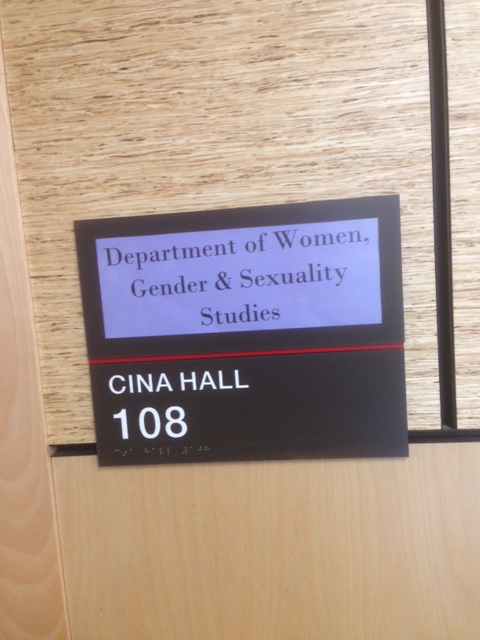
I spent this past weekend in Duluth, where I went to college, with some of my favorite people on earth. We were all Women’s Studies majors, waaaay back in the 90s, and spent a ton of time together. One of our favorite professors was retiring, so it was a good excuse to take a little road trip and have a sleepover party. The retirement party was really nice—a big turnout to thank Beth for all she did for us during college and to wish her well in this new phase of life—and it was a kick to get to see other alums and professors we haven’t kept up with.
Renee, Kelly, Sarah, and I spent hours and hours talking and laughing. We reminisced about college-era things and went back to our school to check out the many upgrades that have happened since our years there. Between the four of us, we were able to dig up a ton of memories and had so much fun talking about those meaningful college years. So much has happened since then. We’re all mothers. We’re all married. Kelly and I spent a decade living two miles apart. There have been road trips while in grad school, travel together to Boston and all over England, births, adoptions, marriages, funerals, and so much shared joy and sadness.
Retirement party for Beth Bartlett, Women, Gender and Sexuality Studies department head.
We didn’t give Beth a retirement card; we gave her a thank you card. We thanked her for our wonderful feminist educations, for helping shape who we are, and for bringing us together as lifelong friends. Being a feminist is probably the most important aspect of my identity. It was punk rock, riot grrrl, and zines that led me to feminism in the early 90s. Choosing Women’s Studies as one of my majors connected me to all of these wonderful other feminists who absolutely fed my brain and spirit as I continued to devour everything I could possibly read about feminism. They supported and challenged me in ways that have affected my entire life. And now, at almost 40, I am not sure that I have any close friends who would not identify (openly, loudly, and quickly) as a feminist. It is so gratifying to be able to talk to all of these smart friends about politics, identity, and parenting, all through a feminist lens. We are raising feminist children. We are still challenging and supporting each other.
And as we walked about UMD, cackling over memories and sighing over favorite classes, I kept thinking how absolutely grateful I am for not listening to the people who asked, snidely, “What will you ever do with a Women’s Studies degree?” I never worried about what I would do with it; I knew a Women’s Studies education would give me a solid look at intersectional feminism. It would teach me about literature, politics, history, psychology, sociology, art, activism, and social justice in ways no other major would. It would educate me and empower me. The added bonus was it also gave me lifelong friends. I will always be so grateful for what the Women’s Studies program did for me, and to me, and for the ways it shaped my life and has influenced the past 21 (gulp) years of my life.


























 AMANDA MACGREGOR